Shipping Testing
Should I Offer Free Shipping?
Free shipping creates a cost that has to come from somewhere. Whether the trade-offs work in your favor depends on how you implement it.
Free shipping sounds simple. But the answer depends on how you implement it, what you sell, and how your customers behave.
Offer it on all orders? A $40 purchase with $7 shipping cost reduces your margin by 17%. A $150 purchase with the same $7 cost? Only 5%. Your margin impact depends entirely on your order value distribution.
Set a threshold at $75? Customers who naturally spend $47 won't stretch their cart. They'll leave. Customers who naturally spend $82? You just gave away free shipping when they would have paid.
Build shipping into your product prices? You protect margin while appearing to offer "free" shipping. But if your prices land 10% above competitors, conversion suffers.
What Actually Happens When You Offer Free Shipping?
Free shipping creates a cost that has to come from somewhere. Whether the trade-offs work in your favor depends on how you implement it.
The impact of free shipping isn't universal. It depends entirely on how you structure it and how your customers respond.
Free shipping on all orders increases conversion for price-sensitive customers but reduces margin on every sale. If your average order is $60 and shipping costs $7, you're absorbing 12% of revenue. That works if conversion increases enough to offset the margin hit.
Free shipping thresholds protect margin on small purchases while encouraging larger carts. Raising your free shipping threshold typically decreases conversion but increases AOV and profit margin. The question is whether the AOV increase compensates for lost sales.
Building shipping into product prices protects margin while appearing to offer "free" shipping. Customers hate seeing shipping fees at checkout. But if your $50 product becomes $57 to cover shipping costs, you need to check how that compares to competitor pricing.
What Are Your Options?
Free shipping comes in multiple forms. Each creates different trade-offs between conversion, order size, and margin.
You're not choosing between "free shipping" and "paid shipping." You're choosing between different implementations of shipping strategy, each with its own set of trade-offs.
Here are the main approaches:
Free shipping on all orders. Simple for customers. Reduces margin on every sale. Works when increased conversion volume offsets the absorbed shipping costs.
Free shipping above a threshold. Protects margin on small purchases while encouraging larger carts. Typically increases AOV but may reduce conversion if the threshold sits above where orders naturally cluster. The trade-off depends on your order distribution.
Paid shipping (flat rate or carrier-calculated). Covers costs directly. How much you charge for shipping determines whether customers accept the cost or abandon their carts.
Build shipping into product prices. Offer "free shipping always" while protecting margin. Converts better than showing a shipping fee if your final price remains competitive. When building shipping into your product prices, make sure your base prices are optimized first.
Conditional free shipping. Members only, promotions, or seasonal. Creates urgency but adds complexity.
Each approach creates different trade-offs between conversion, AOV, and margin. The question isn't which approach is "best." The question is which one increases profit per visitor for your specific business.
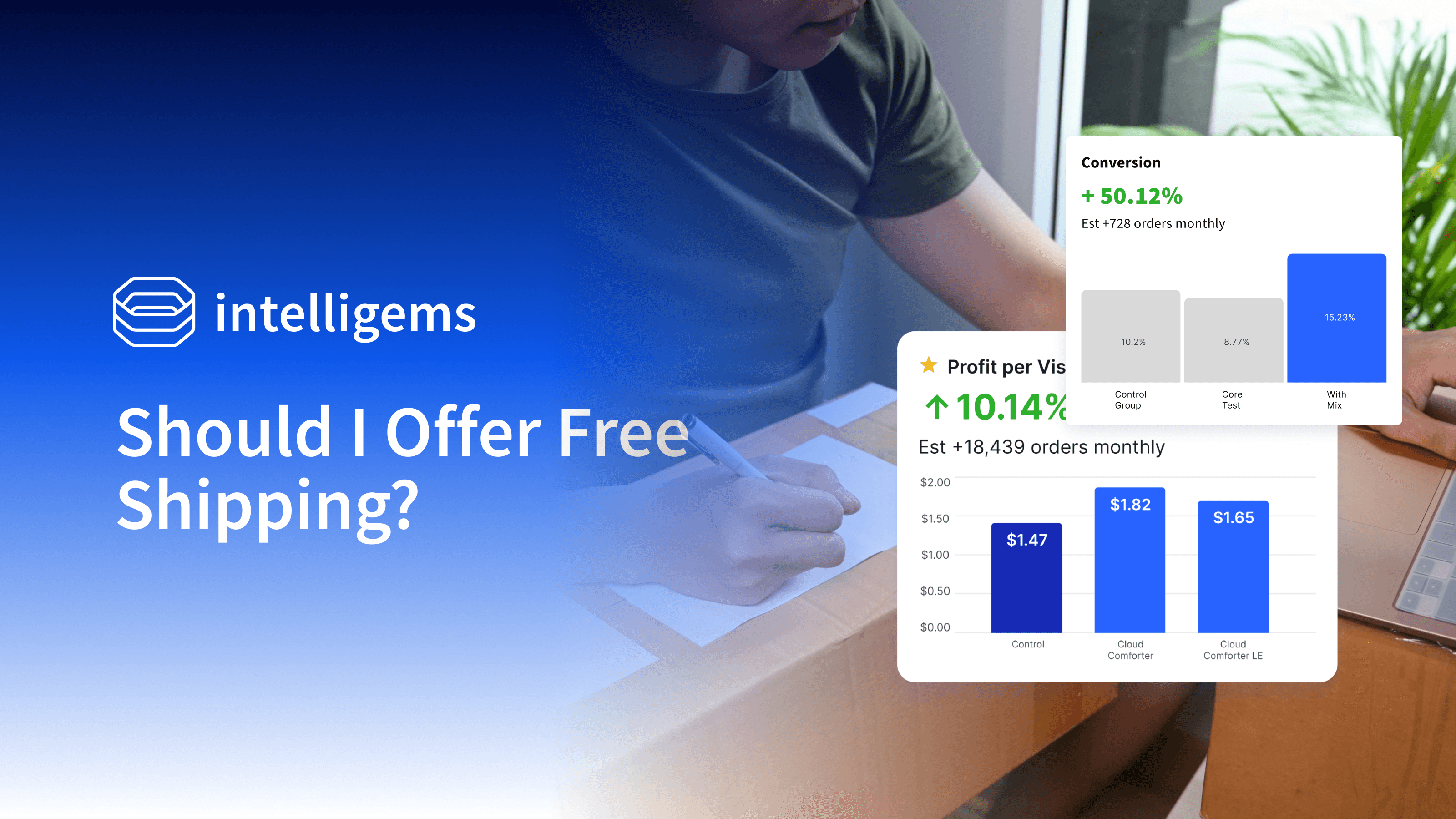
See a real example of shipping rate testing in action. In this case study, charging $4.99 for shipping (instead of free) increased profit per visitor by 10% AND boosted conversion by 3.6%. The middle price point won.
Why Does Profit Per Visitor Matter?
Free shipping might increase conversion and hurt margin. Or increase AOV and improve margin. The question is: which scenario applies to you?
It's easy to focus on conversion rates. But conversion isn't what pays the bills. What matters is profit per visitor: the amount of profit you generate from each person who visits your store.
The formula is simple: Profit per visitor = (Product margin + Shipping margin) ÷ Total visitors.
Free shipping changes both sides of this equation. Consider a concrete example:
Your baseline: 10,000 visitors, 2% conversion (200 orders), $80 AOV, 60% product margin, $6 average shipping cost. Your profit per visitor is $0.84.
Scenario A: Free shipping on all orders. Conversion increases to 2.5% (250 orders) but you absorb $6 shipping cost per order. Margin drops to 52.5%. Profit per visitor increases to $1.05. The conversion lift compensates for the margin hit.
Scenario B: $100 free shipping threshold. Conversion decreases to 1.9% (190 orders) but AOV increases to $110 and margin improves to 64% (fewer small orders). Profit per visitor increases to $1.34. Lower conversion, higher profit.
Scenario C: Build shipping into product prices. Conversion increases to 2.2% (220 orders), AOV stays at $80, margin stays at 60%. Profit per visitor increases to $1.06.
Which scenario applies to your business? That depends on how your customers respond to each implementation. Guessing based on what competitors do means optimizing for someone else's business, not yours.
What's the Simplest Test I Can Run?
Start simple. Test whether free shipping beats paid shipping. Then test different implementations to find what works best.
You don't need a complex testing strategy to figure out your free shipping approach. Start with the basics, then optimize from there. If you're new to testing, learn the fundamentals of setting up your first test before diving into shipping optimization.
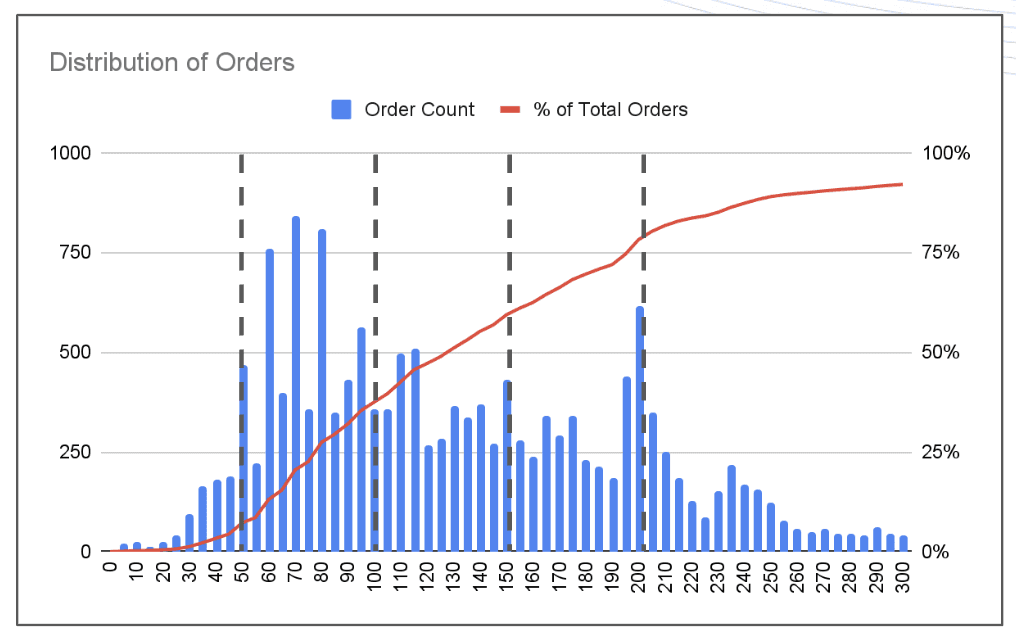
Step 1: Analyze your current state. Pull your order data from the past 90 days. Where do orders naturally cluster? Those clusters tell you how your customers naturally shop. Use Shopify's order reports to see your order distribution.
Step 2: Test free shipping vs. paid shipping. If you currently charge for shipping, test offering it free. If you currently offer it free, test charging for it (or raising your threshold). Measure profit per visitor, not just conversion or AOV. This tells you whether the trade-off works in your favor.
Step 3: Test different threshold amounts. If thresholds look promising, test where they should sit. If orders cluster between $50 and $200, test $50, $100, and $150. A $200 threshold would be too aggressive. Align thresholds with where customers naturally shop, not where you wish they'd shop.
Step 4: Test alternative implementations. Maybe building shipping into your product prices and offering "free shipping always" converts better than a threshold-based approach. Or maybe flat rate shipping ($5 on all orders) beats carrier-calculated rates. Test to find out.
Run each test for at least one week to account for weekly patterns. Measure profit per visitor as your primary metric: it tells you whether the change actually makes you more money.
Watch an analysis of a real shipping threshold test comparing $75 vs $100 vs $125. Multiple thresholds performed well for different reasons, showing why testing reveals nuances that assumptions can't.
Common Mistakes That Keep You Uncertain
The biggest mistake is optimizing for the wrong metric, or not testing at all.
Here's what trips up most shipping strategies:
Only looking at conversion. Conversion increases from 2% to 2.2% look good until you realize margin dropped from 60% to 45%. Profit per visitor decreased even though conversion improved. A 10% conversion lift with a 15% margin drop destroys profitability.
Not accounting for shipping costs. If you're absorbing $7 per order on a $50 product, that's 14% of revenue gone. Factor shipping costs into your profit margin calculation. "Free" shipping isn't free.
Copying competitors. Your competitor's $75 threshold might work for their $40 average order value and 70% margins. Your AOV is $62 with 55% margins. Copying their strategy means optimizing for their economics, not yours.
Setting thresholds without data. Orders cluster at $47? Your $75 threshold forces customers to add $28 more. They won't stretch. They'll abandon. Orders cluster at $82? Your $75 threshold gives away free shipping to customers who would have paid. Your threshold should align with how customers actually shop.
Not testing. Every assumption about customer behavior is a hypothesis. Validate it with data instead of guessing.
Stop Guessing. Start Knowing.
Free shipping sounds like a requirement. Your competitors do it. Amazon does it. So you should too, right?
Maybe. Or maybe not. Free shipping creates trade-offs, and whether those trade-offs work in your favor depends on your specific economics and customer behavior.
Here's what to do:
Start with your order data. Analyze where orders cluster over the past 90 days. This tells you whether thresholds make sense and where to set them.
Test free vs. paid shipping. Measure profit per visitor, not just conversion or AOV. The metric that matters is how much profit you generate per store visitor.
If thresholds look promising, align them with order clusters. Not arbitrary round numbers. $75 looks clean but means nothing if orders cluster at $47 or $110.
Compare alternative implementations: built into prices, flat rate, conditional offers. Each creates different trade-offs.
Ignore what competitors do. Their margins, AOV, and customers differ from yours. Optimize for your economics, not theirs.
Ready to test your shipping strategy but not sure where to begin? Start here with a complete guide to getting started with Intelligems.
Don't guess whether to offer free shipping. Know!
Ready to find out whether free shipping actually increases your profits? When you're ready to test what works for your business, let's get you testing beyond what's typical.
AB Testing
Ecommerce Strategy
AB Testing