
Ecommerce Strategy
How Should a Solo Founder Approach A/B Testing
You don't need a testing program. You need to learn how to read your data for signals that point to high-leverage opportunities.
You're running everything. Product sourcing, customer service, ads, fulfillment. Maybe you've got a VA helping with the basics, but the strategic decisions? Those are all you.
So when someone suggests A/B testing, you're probably thinking: "I barely have time to answer emails. How am I supposed to run experiments?"
You don't need a testing program. You need to learn how to read your data for signals that point to high-leverage opportunities. The goal isn't to test everything. It's to let your data guide you toward the tests that matter most for YOUR situation.
Where You Are
Your most valuable resource isn't money. It's your attention. Every hour you spend on testing is an hour you're not spending on product, marketing, or customer relationships.
You probably don't have a developer. Your site runs on a standard Shopify theme with maybe a few apps. And honestly? That's fine. The best tests at your stage require zero code.
Success looks like this: running one test per month that actually moves the needle on profit. Not conversion rate theater. Real profit changes you can feel in your bank account.
Your Testing Philosophy
Maximum ROI per hour invested.
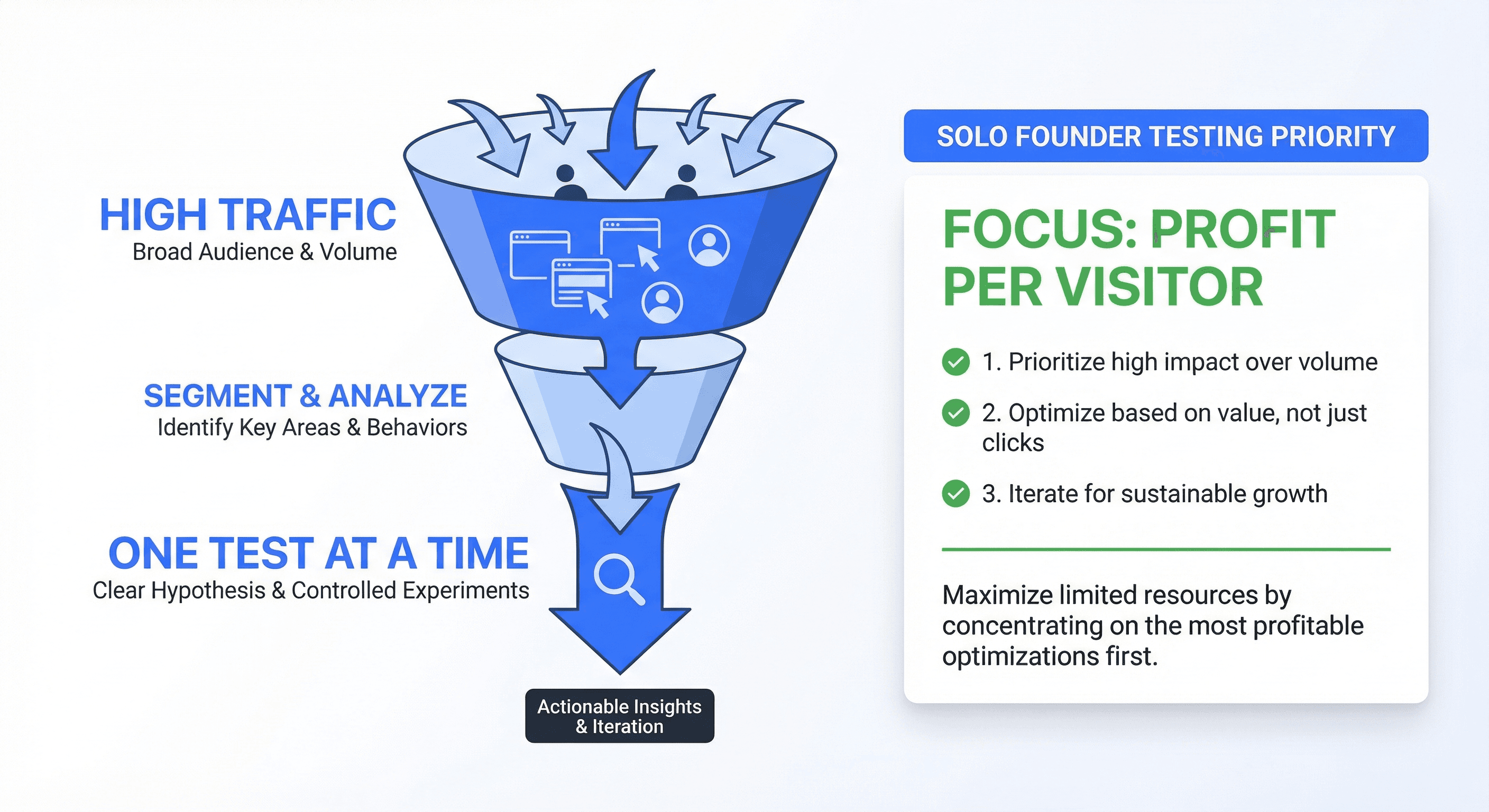
Forget the testing roadmap with 47 experiments. You need to discover one big lever at a time. Find the signal, explore it, implement what works, move on.
The opportunities worth your time share three characteristics:
They take less than 30 minutes to set up
They test something that directly impacts revenue or margin
They give you a clear answer you can act on
Everything else is a distraction. You can build a sophisticated testing practice later. Right now, you need to discover what works for your specific business.
5 Data Signals to Explore as a Solo Founder
1. Price Straddle Test
Your data signal: You set your prices based on competitor research or gut feel, not customer willingness to pay.
If you're seeing this pattern, your pricing might be one of the highest-leverage opportunities available to you. A 5% price increase on a $50 product is $2.50 extra per order... with zero additional work.
Price testing 101: The fundamentals for founders who need fast results.
The question is whether customers will pay more. Or if you're actually losing sales by pricing too high. Your current data can't tell you this without exploration.
Why this could matter for a solo founder: Takes 10 minutes to set up. No code. No design changes. Just price adjustments that Intelligems randomizes across visitors.
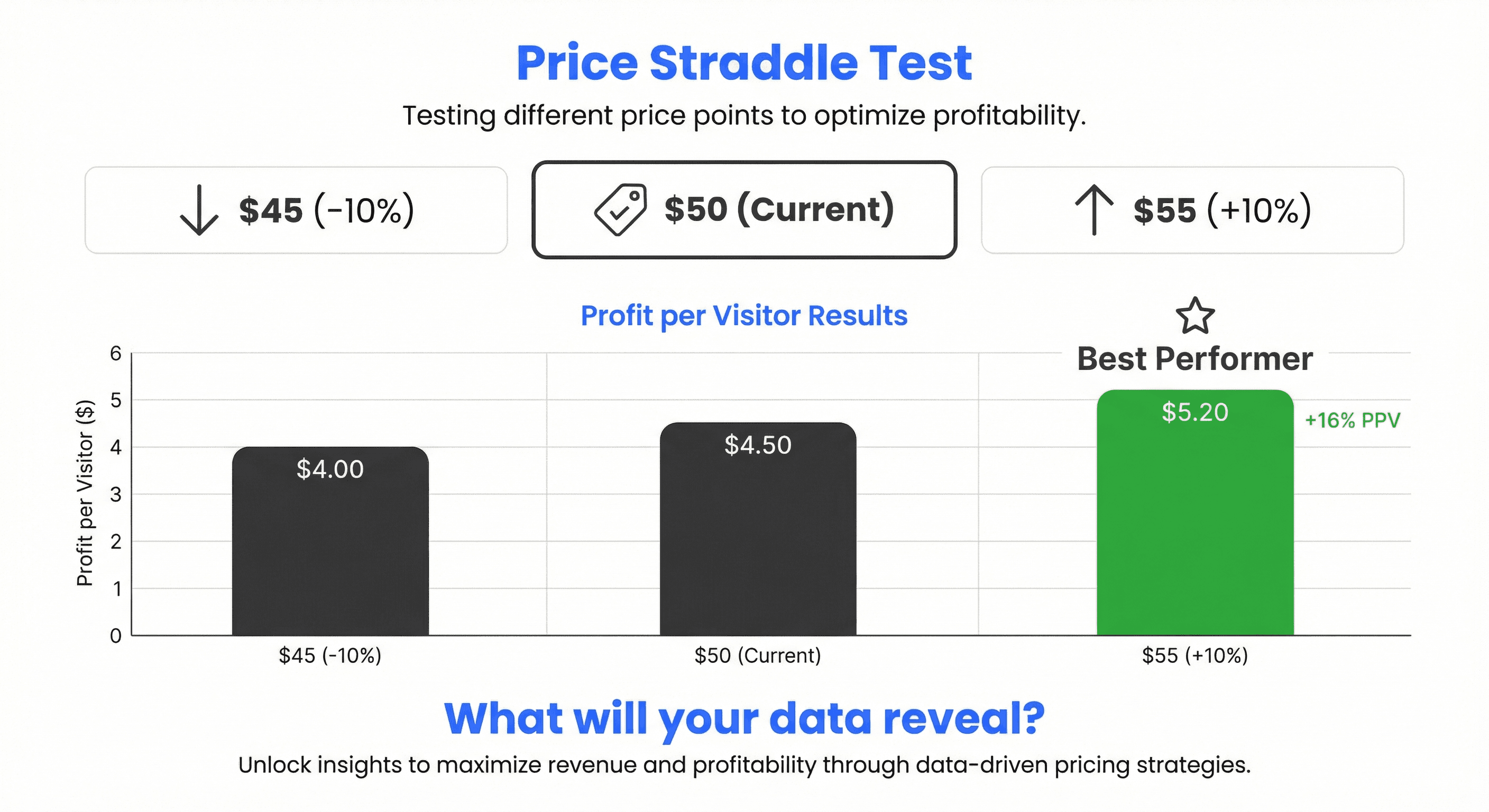
What you might explore: Create three variants. Your current price, 5-10% higher, and 5-10% lower. Split traffic evenly and see what the data reveals.
Track this to understand: Profit per visitor, not just conversion rate. A lower price might convert better but make you less money per customer.
2. Free Shipping Threshold Optimization
Your data signal: You picked a free shipping threshold based on what felt right, not what actually maximizes profit.
This pattern often points to an opportunity worth investigating. Free shipping thresholds are one of the most powerful tools for increasing AOV. But the wrong threshold either costs you profit or creates friction that kills conversions.
Founders often set their threshold at their average order value. But that might be backwards... your threshold could potentially work better slightly above your median, pushing customers to add just one more item.
Why this could matter for a solo founder: Change it once in Shopify settings. No development needed. Intelligems can test multiple thresholds simultaneously.
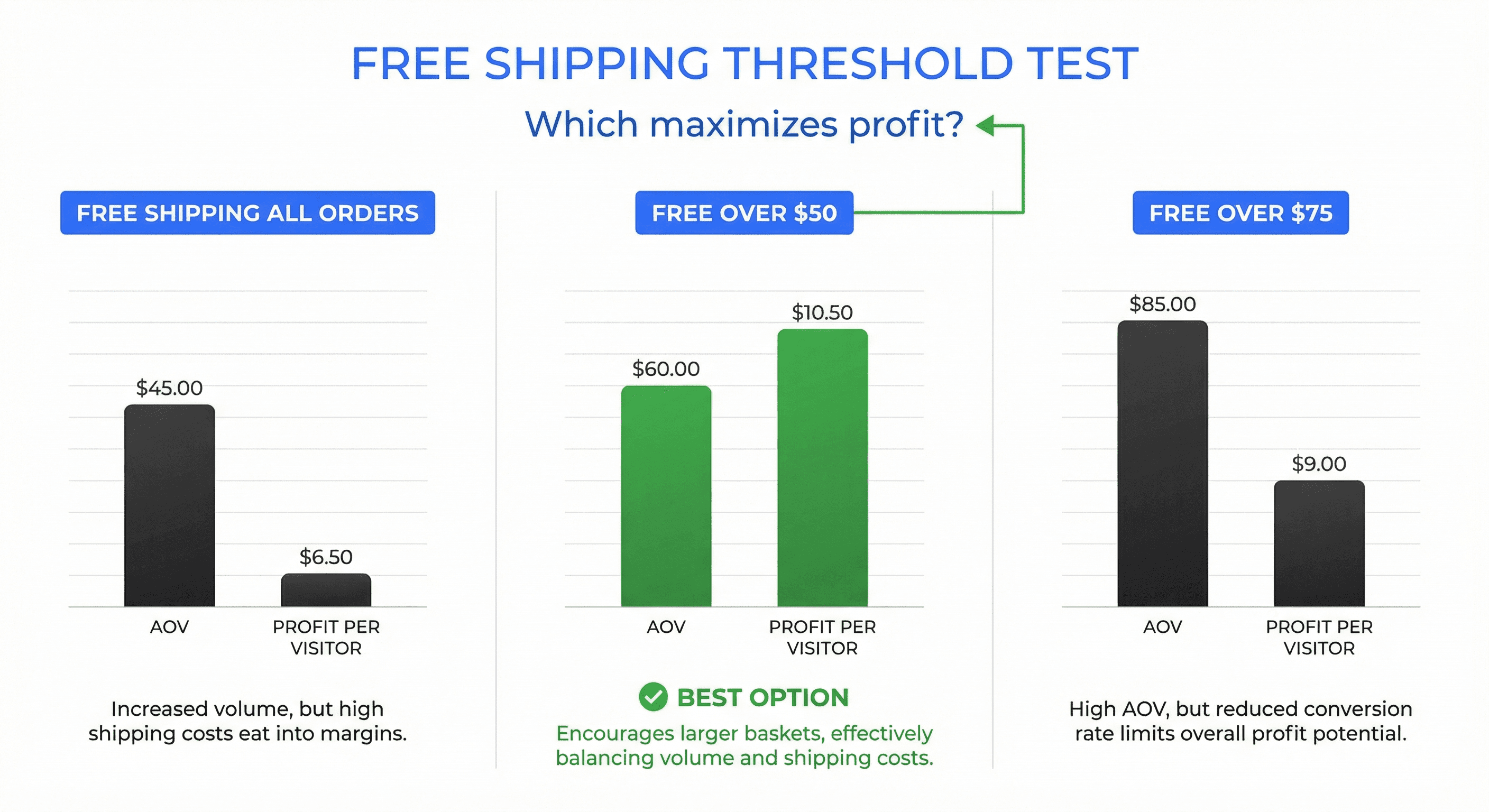
What you might explore: Your current threshold vs. $10-15 higher vs. $10-15 lower. Or explore free shipping on all orders vs. a threshold to see which pattern fits your customers.
Track this to understand: Profit per visitor, AOV, and shipping cost per order. Watch whether the threshold increase actually covers the lost margin on shipping.
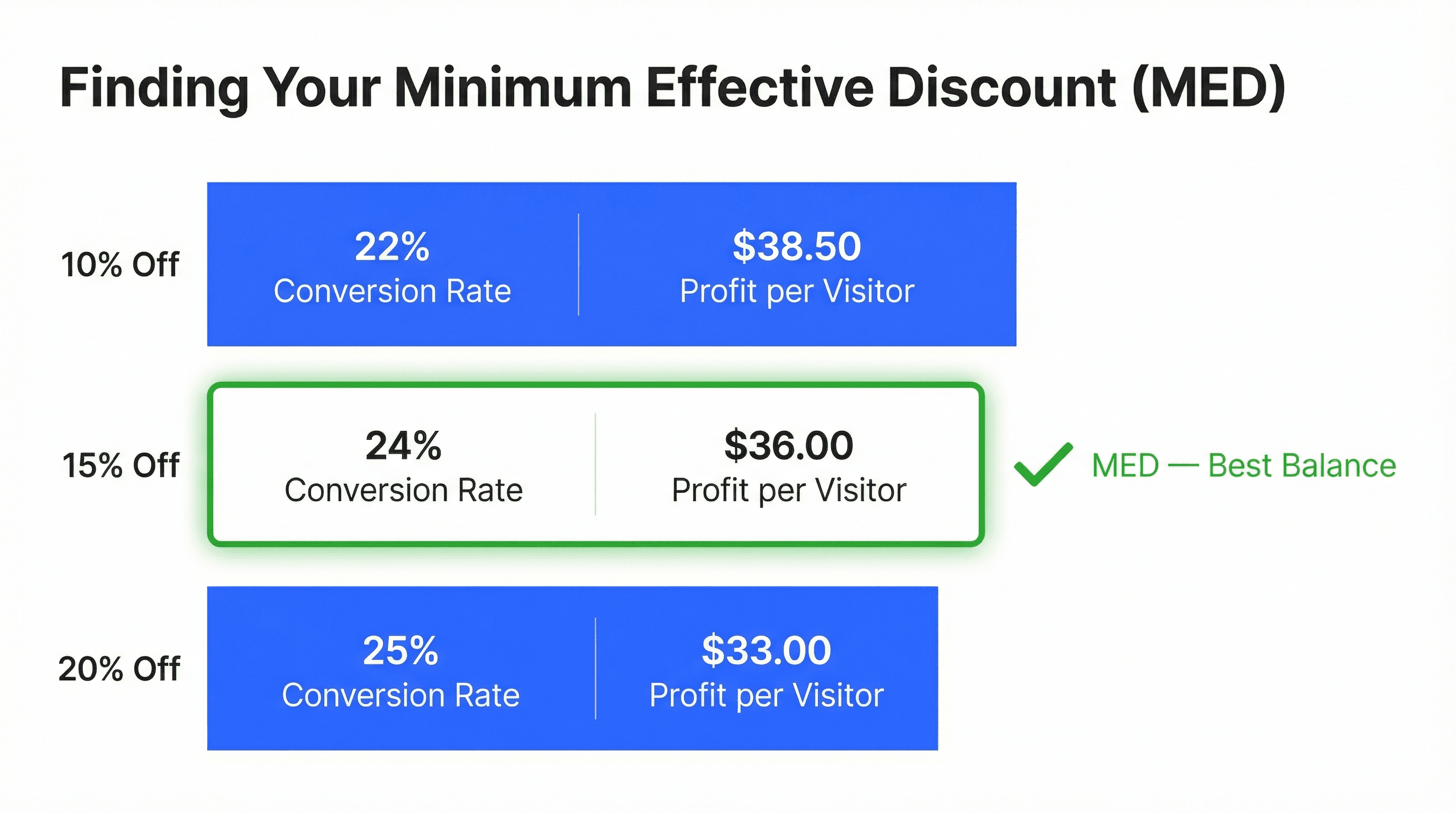
3. Discount Depth Testing (Finding Your MED)
Your data signal: You default to 20% off because that's what everyone does, without knowing if 15% would work just as well.
If this describes your situation, you might be giving away margin unnecessarily. Your Minimum Effective Discount (MED) is the smallest discount that still drives the behavior you want. Every percentage point above that could be profit you're giving away for free.
If 15% off converts the same as 20% off, you might be losing 5% margin on every discounted order. For a $10,000 month in discounted sales, that could represent $500 in unnecessary margin erosion.
Why this could matter for a solo founder: You're probably already running promotions. This exploration just makes them smarter. Discover the pattern once, apply the learning to every future sale.
What you might explore: Your standard discount vs. 5% less vs. 5% more. Run it during your next promotion period and see what your customers actually respond to.
Track this to understand: Profit per visitor, redemption rate, and margin impact. The winner isn't the highest conversion rate... it's the highest profit.
4. Subscription Default for Repeat Products
Your data signal: You sell consumables or repeat-purchase products but subscription is buried in your product page.
If you sell something customers need to reorder... supplements, skincare, pet food, coffee... this pattern could indicate a significant opportunity. Subscription might work better as the default option, not a hidden checkbox.
Pre-selecting "Subscribe & Save" isn't tricking customers. It's helping them get better value while giving you predictable revenue. But you need to explore whether your customers actually prefer it.
Why this could matter for a solo founder: One change to your product page template. If it works, it builds recurring revenue while you sleep.
What you might explore: Subscription pre-selected vs. one-time purchase pre-selected. Keep the option to switch clearly visible and see how customers respond.
Track this to understand: Subscription rate, first-order profit per visitor, and churn rate over 60 days. Learn about pricing subscription plans to optimize retention.
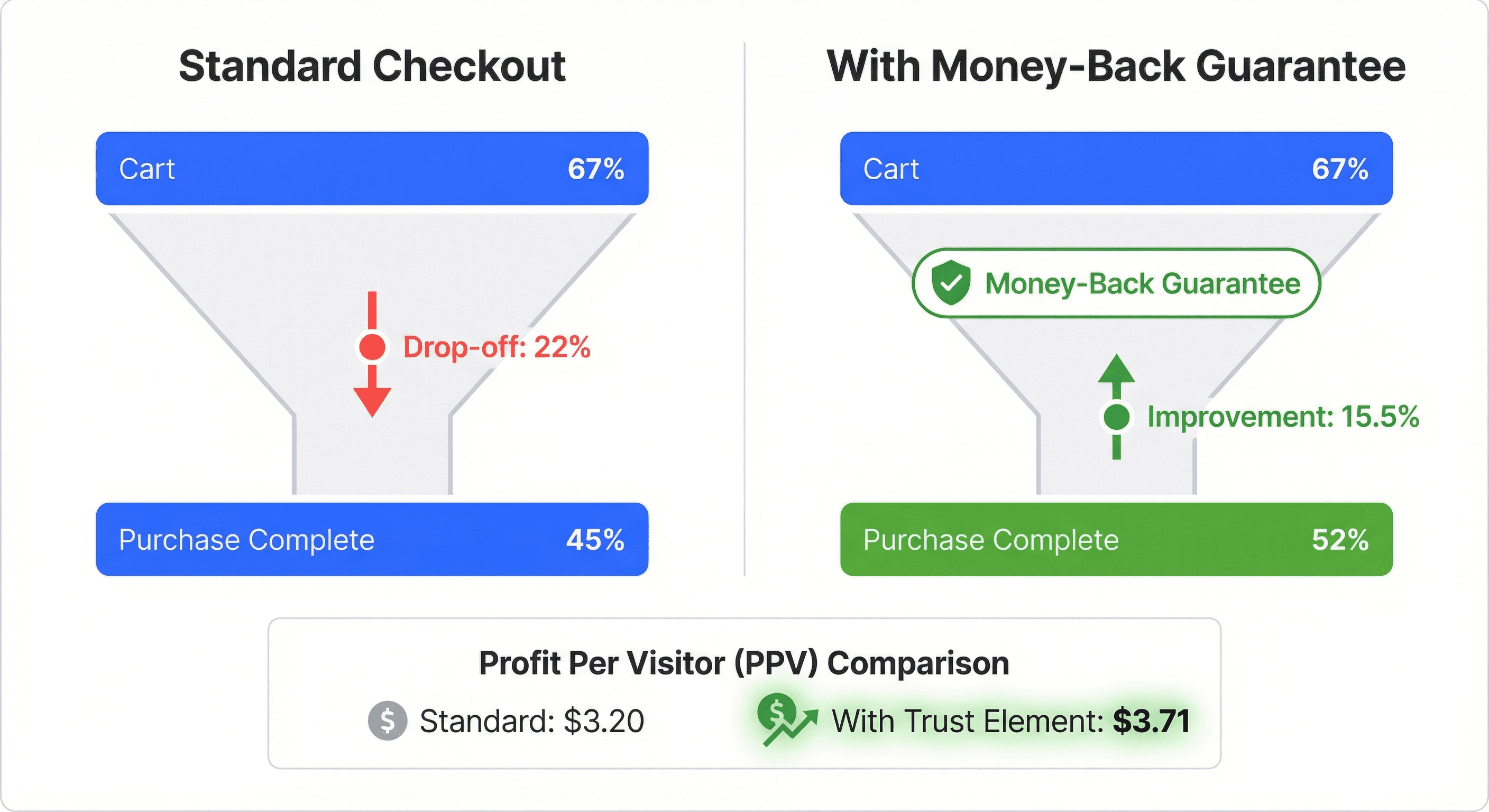
5. Checkout Trust Messaging
Your data signal: Customers abandon checkout at a higher rate than industry benchmarks, especially first-time buyers.
This pattern often points to a trust gap worth investigating. Your checkout is where trust matters the most. Customers are about to hand over their credit card to a brand they might have just discovered.
One trust element in the right place could reduce checkout abandonment significantly. But loading your checkout with 17 badges and guarantees creates clutter. The exploration is finding what resonates with your specific customers.
Why this could matter for a solo founder: Add one trust element. Explore whether it helps. Done. No ongoing maintenance required.
What you might explore: Your current checkout vs. checkout with ONE added trust element. Options worth investigating: money-back guarantee text, security badge, customer review count, or shipping guarantee.
Track this to understand: Checkout completion rate and profit per visitor. If completion goes up without affecting AOV, you've discovered something valuable.
Your Data Points the Way
Look at these signals. Which one feels most relevant to your business right now?
Pick ONE area to explore for 2-4 weeks depending on your traffic.
Implement what you learn and move on.
Repeat next month with the next signal that catches your attention.
Your data tells you what to test. These signals are starting points for your stage, not a checklist. The goal is developing the habit of reading your data and letting it guide your exploration.
Want to find your ONE high-leverage test without a team or a testing roadmap? Join GEM Academy — free courses and a community of brands sharing what's working.
AB Testing
AB Testing
AB Testing


