
AB Testing
5 Experiments Fashion Brands Should Run
Fashion is one of the most data-rich categories in ecommerce. Every collection launch, every seasonal transition, every size run generates signals about what your customers actually value.
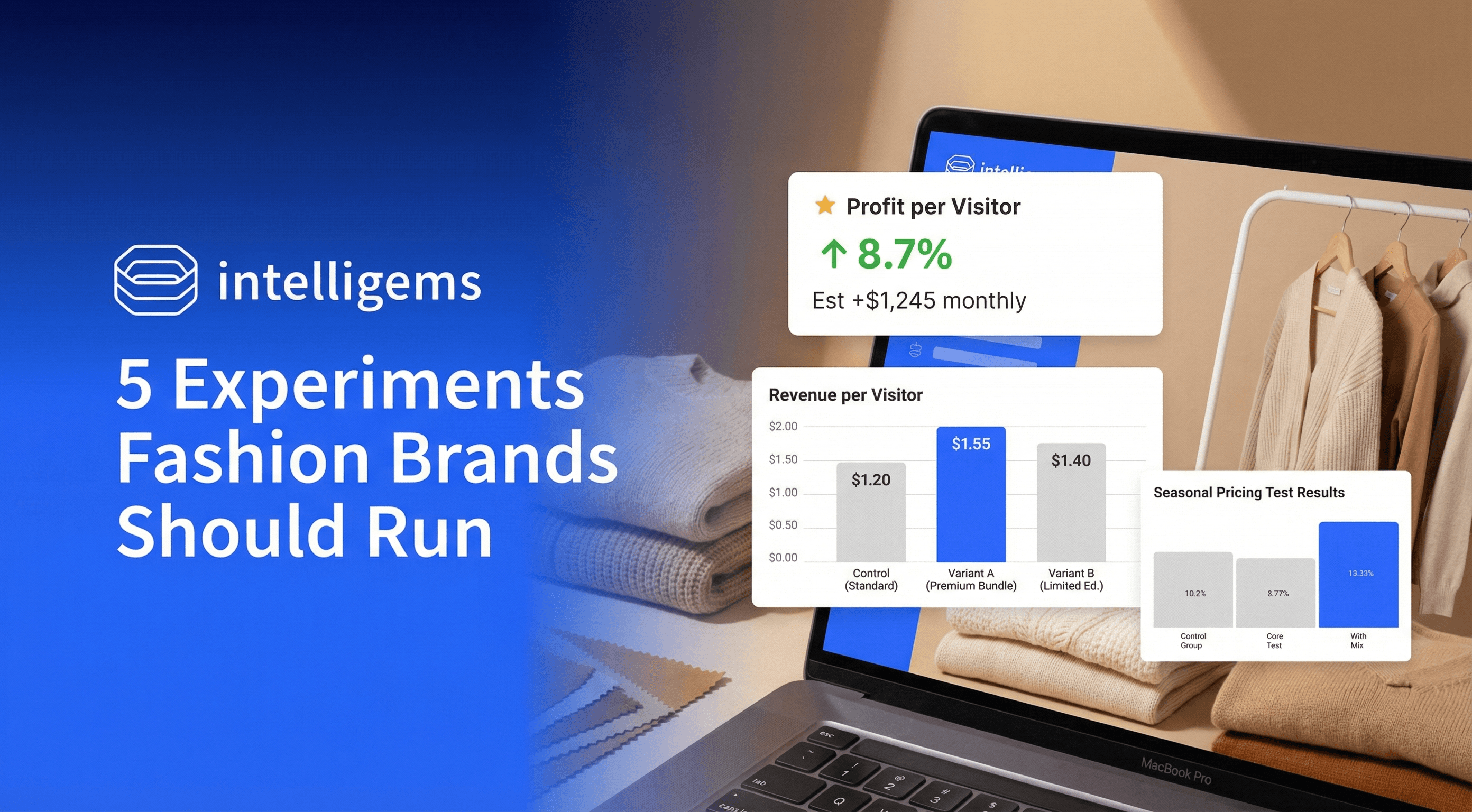
Fashion is one of the most data-rich categories in ecommerce. Every collection launch, every seasonal transition, every size run generates signals about what your customers actually value. The problem? It's tempting to treat pricing and promotions as creative decisions rather than analytical ones.
The best fashion operators know something different. They understand that your data is constantly whispering insights about where margin is being left on the table, where friction is killing conversions, and where customers would happily pay more. The question isn't whether these opportunities exist in your business. The question is whether you're listening.
Here are five experiments that fashion brands should run, each framed around the data signals that tell you it's time to test. Because knowing if your prices are right starts with reading what your numbers are already telling you.
Is Your Collection Pricing Leaving Money on the Table?
Your data is telling you something if conversion rates vary wildly across collections while traffic remains consistent.
Signal: If you're seeing one collection convert at 4% while another converts at 1.5%, despite similar traffic quality and merchandising, that's not just a product problem. It's a pricing signal.
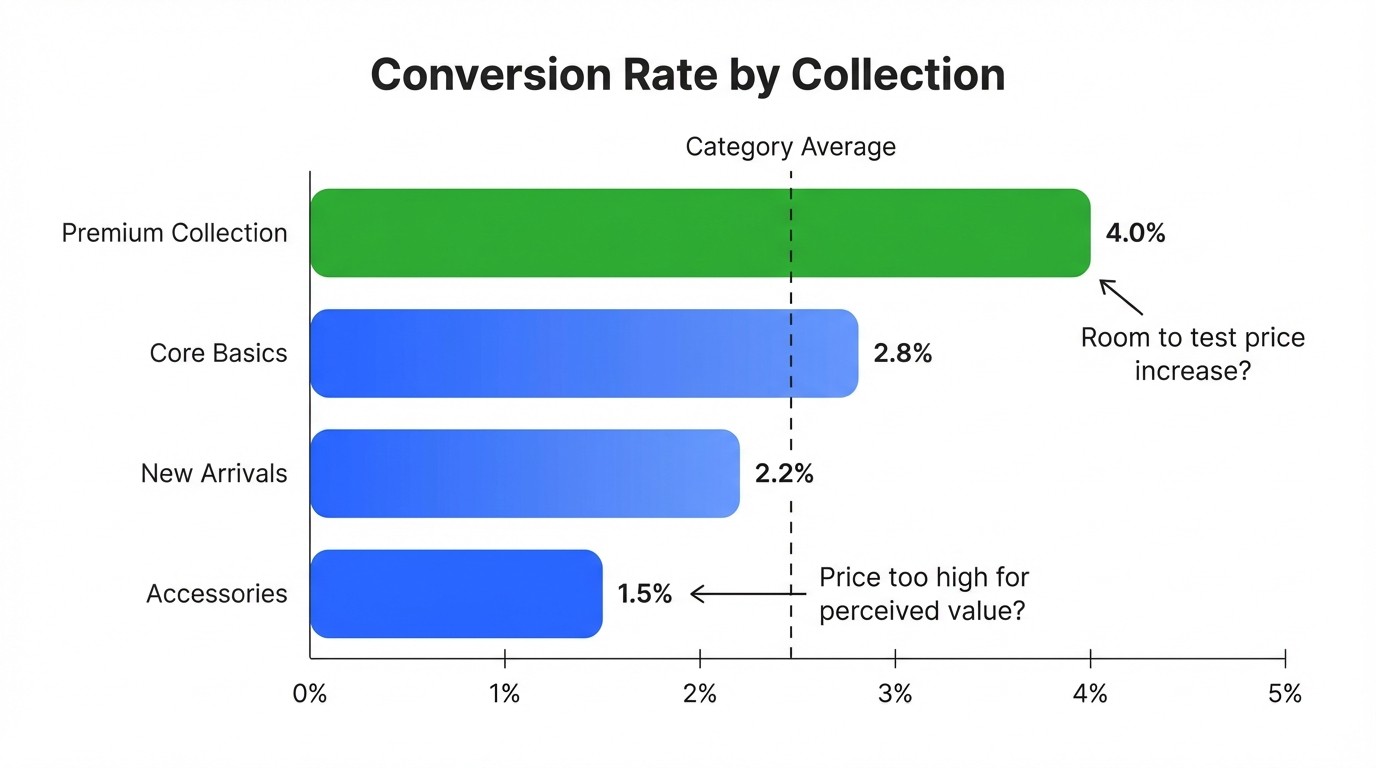
Hypothesis: Uneven conversion across collections often indicates pricing misalignment with perceived value. Your basics collection might be priced too high relative to competitors, while your premium line might actually have room to increase prices without hurting conversion.
Test: Run a price test on your lowest-converting collection first. Test a modest price decrease (10-15%) against your control. Simultaneously, test a price increase on your highest-converting collection to see if demand holds.
Measure: Track profit per visitor across both tests. A lower price that tanks margin isn't a win. You're looking for the combination that maximizes profit per visitor across your entire catalog, not just conversion rate on any single collection.
This episode reveals that two-thirds of price tests show lower prices win—but the answer depends heavily on your margin profile. High-margin fashion brands often have more flexibility to test lower prices.
When Should You Actually Start Marking Down Seasonal Inventory?
Sell-through velocity in weeks 3-4 of a season predicts whether you'll clear inventory profitably or resort to desperate discounting.
Signal: If your sell-through rate drops below 60% by mid-season while inventory aging reports show stock sitting longer than 45 days, you're heading toward margin-destroying markdowns.
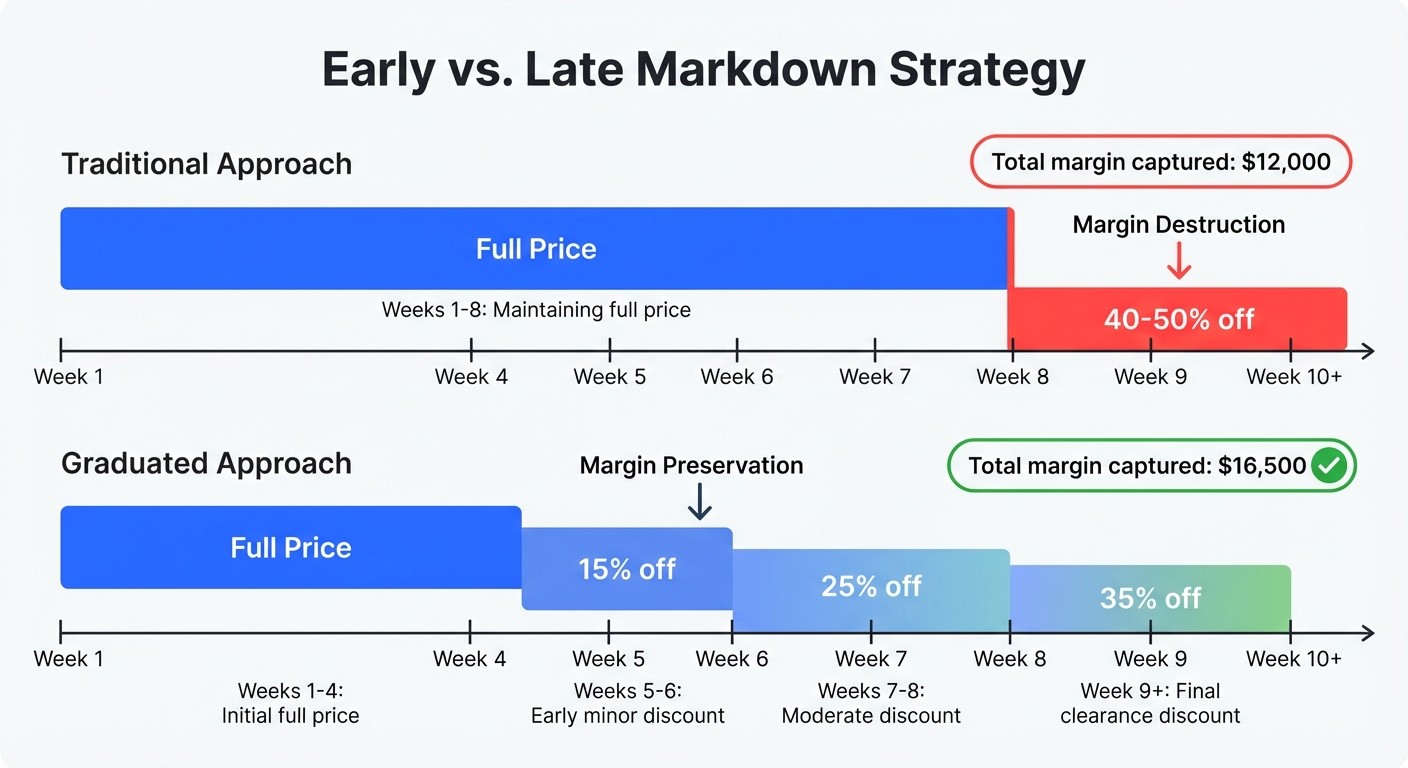
Hypothesis: Most fashion brands wait too long to take initial markdowns, then overcorrect with deep discounts. Earlier, shallower markdowns often generate better profit margins than late-season fire sales.
Test: Instead of waiting for end-of-season clearance, test graduated markdown timing. Take 15% off slow movers at week 4, then measure whether that accelerates sell-through enough to avoid the eventual 40-50% markdowns. Compare total profit per unit against your traditional markdown calendar.
Measure: The metric that matters is total profit captured per SKU across its lifecycle, not just the margin on early full-price sales. Understanding how much you should discount requires measuring the full picture, including the margin destruction that comes from waiting too long.
Review our best practices for experimentation to structure these tests effectively.
Are Bundles the Key to Breaking Through Your AOV Ceiling?
When your AOV clusters tightly around a specific number, customers are mentally anchoring to a spending threshold you can unlock.
Signal: If your Shopify analytics show AOV clustering between $75-85 while your average product price is $45, customers are buying single items and leaving. That clustering pattern is a signal that spending thresholds exist.
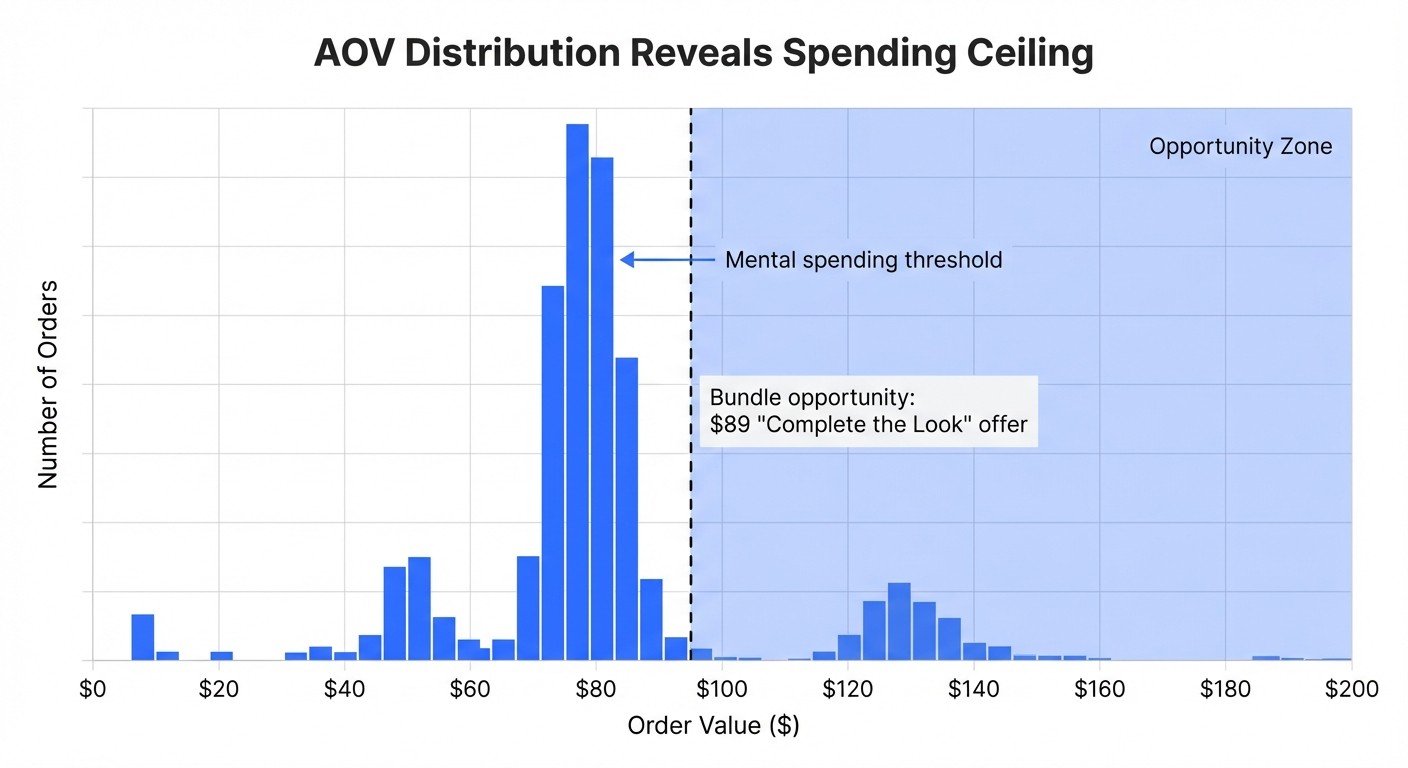
Hypothesis: Fashion customers often shop with a mental budget. Bundles that offer perceived value just above their natural threshold can capture incremental spend they were already willing to make elsewhere.
Test: Create "complete the look" bundles priced 10-15% below the sum of individual items, targeting a total just above your current AOV cluster. Test bundle placement on product pages versus a dedicated bundles collection. Test whether styling bundles outperform purely discount-driven bundles.
Measure: Track incremental profit per visitor, not just AOV lift. A bundle that increases AOV by $20 but costs you $25 in margin compression is moving backward. The winning bundle configuration increases both revenue and profit per visitor. Consider whether tiered discounts or flat discounts work better for your bundle pricing strategy.
Is Your Hero Product Priced for Maximum Profit?
High traffic combined with conversion rates below category benchmarks on your bestsellers signals pricing friction on your most valuable real estate.
Signal: If your top three traffic-driving products show conversion rates 30% lower than similar items in your catalog, something is creating friction. When customers are seeking out a product but not buying, price is often the culprit.
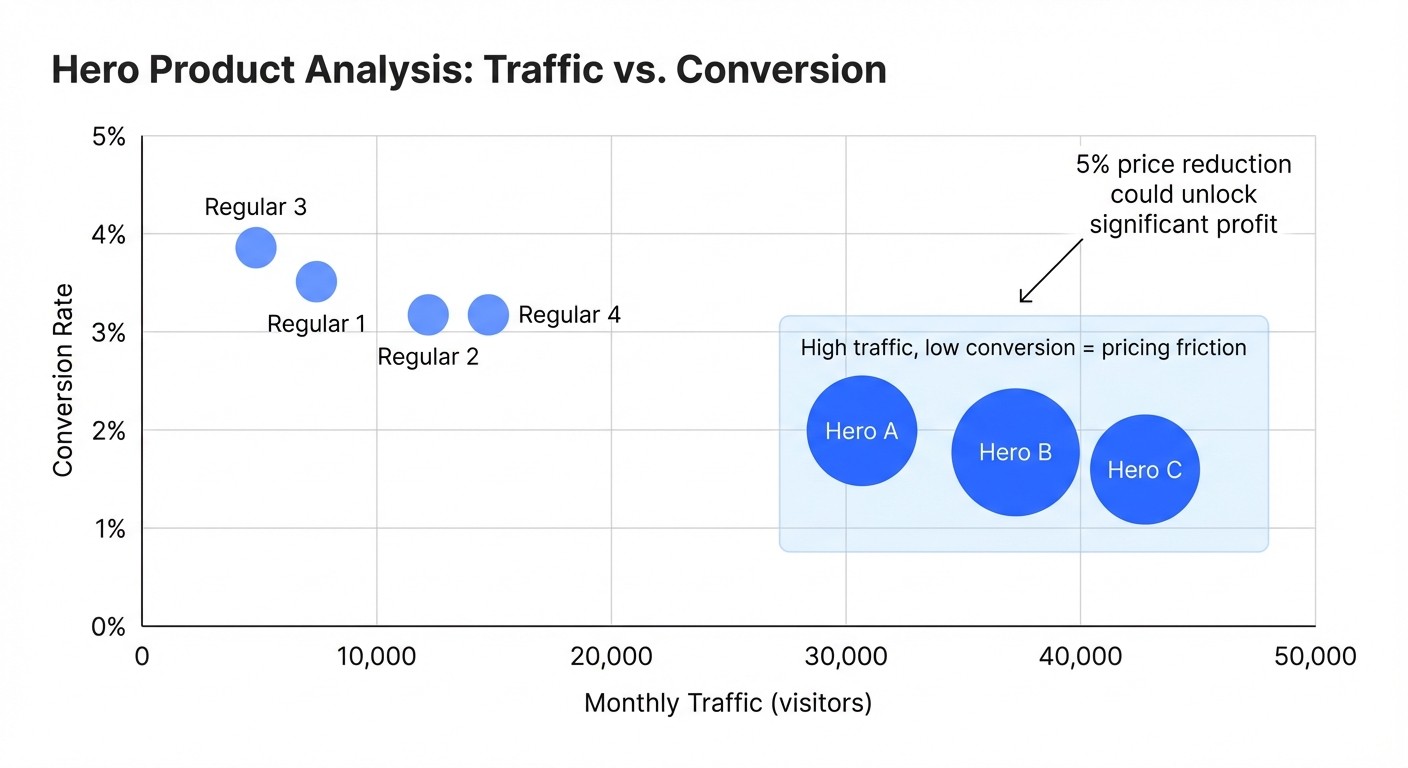
Hypothesis: Hero products carry brand perception weight. Customers comparison-shop bestsellers more aggressively, and even small pricing advantages can unlock significant conversion improvements without destroying perceived value.
Test: Test modest price adjustments (5-10% in either direction) on hero products. The goal isn't to find the cheapest price that converts. It's to find the highest price that doesn't create meaningful conversion friction. Test whether charm pricing ($99 vs $100) impacts conversion differently on high-visibility items.
Measure: Because hero products drive discovery and often lead to multi-item carts, measure total session profit per visitor, not just conversion on the hero item itself. A small conversion lift on a hero product can cascade into meaningful profit gains across your entire catalog. Understanding whether raising prices will hurt your sales is essential before making changes to your bestsellers.
This foundational episode explains the straddle approach—testing 5-10% above and below your current price—perfect for finding the optimal price point on hero products without taking big risks.
Should Extended Sizes Carry Different Price Points?
If your size distribution data shows outsized demand for extended sizes while margins compress due to higher production costs, you have a pricing misalignment.
Signal: When 25% of your sales come from extended sizes but your size cost data shows these SKUs cost 15-20% more to produce, you're subsidizing larger sizes with margin from core sizes. That's a structural problem worth testing.
Hypothesis: Many fashion customers in extended sizes are underserved by the market and may be willing to pay a modest premium for quality, fit, and availability. The key is testing whether a small upcharge affects demand or simply aligns pricing with costs.
Test: Test a $3-5 upcharge on extended sizes in specific categories. Compare conversion rates and profit per visitor against the control group. Test whether transparent communication about quality and fit investment changes customer response to the upcharge.
Measure: This test requires measuring both immediate profit per visitor impact and longer-term customer behavior. Track whether the upcharge affects repeat purchase rates from extended-size customers. A short-term margin win that destroys lifetime value isn't a real win. Learn how to set up a price test to structure this experiment properly.
Stop Guessing. Start Knowing.
Fashion brands have more data than ever, but data without action is just noise. Every signal in your analytics represents a hypothesis waiting to be tested and an opportunity to capture margin you're currently leaving on the table.
The experiments above share a common thread:
Start with signals, not assumptions. Let your data tell you where to test.
Measure what matters. Profit per visitor reveals the truth that conversion rate and AOV hide.
Test before you commit. Hunches are expensive. Validated insights compound.
Winning in fashion doesn't require better creative instincts. It requires treating pricing and promotions as an ongoing optimization practice rather than a set-it-and-forget-it decision.
Ready to discover what experiments will move the needle for your fashion brand? When you're ready to let your data guide your testing, let's get you testing beyond what's typical.
AB Testing
AB Testing
AB Testing


