Discounts
How deep should my Black Friday discount be?
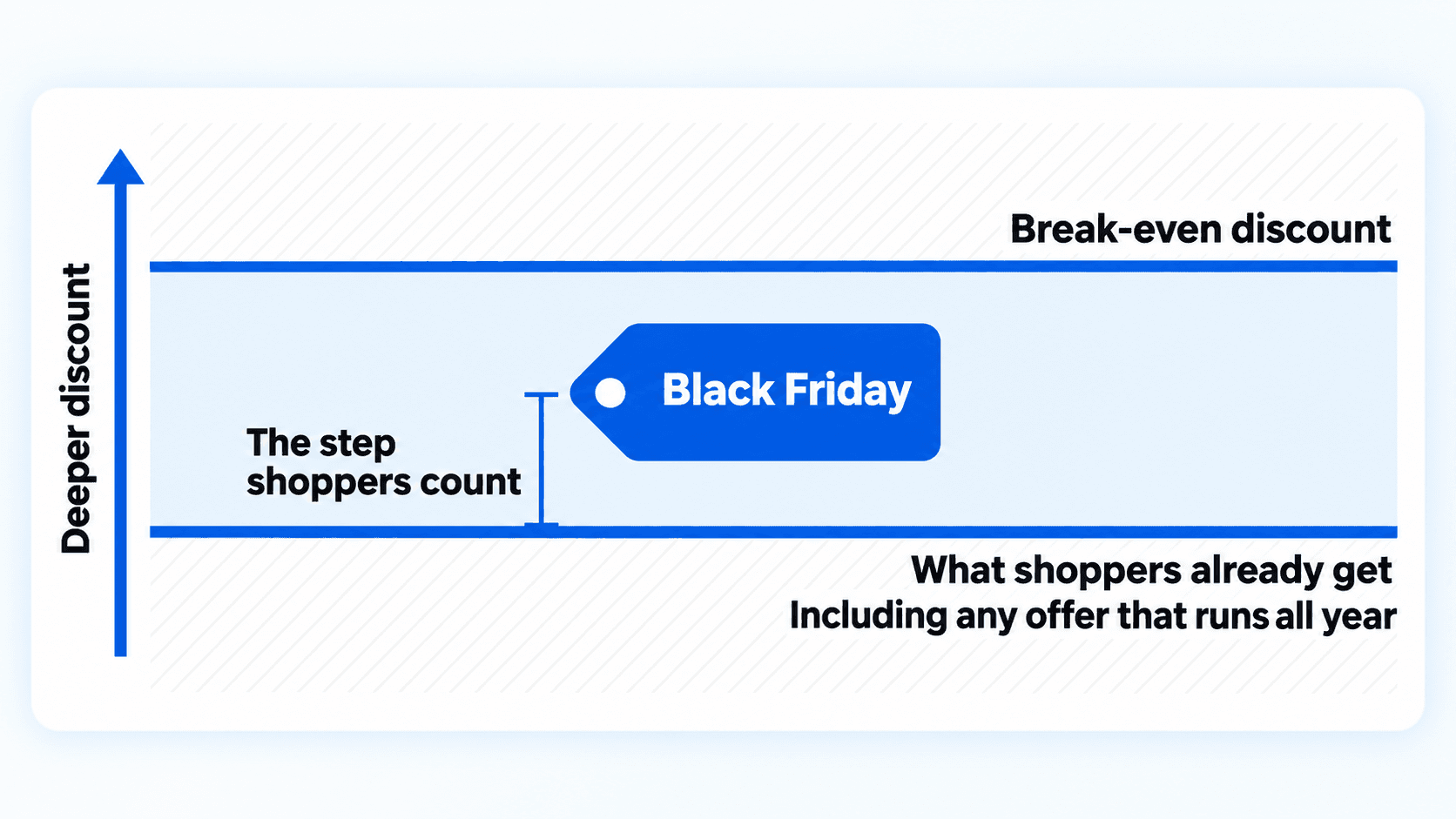
Your depth sits between your margin and what shoppers already get.

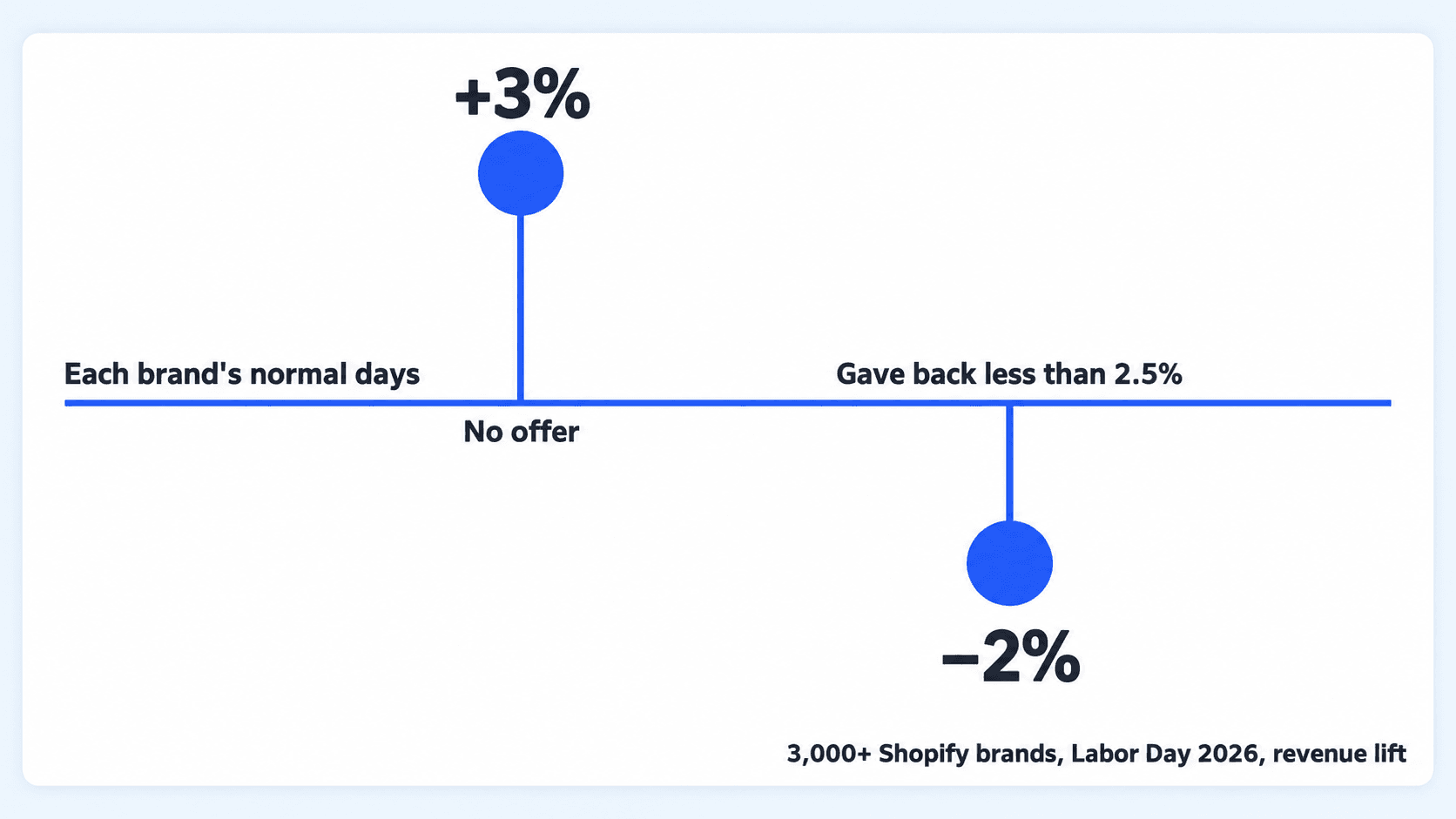
Your depth sits between a ceiling your margin sets and a floor set by what shoppers already get, at the smallest point that still changes behavior. In Intelligems’ review of 3,000+ Shopify brands’ Labor Day 2026 weekend, brands that gave back less than 2.5% saw revenue drop 2% against their own normal days.
Repeating last year’s depth is the easy default; the better question is what that depth actually bought you.
Too deep and too shallow both cost you
Your team is arguing over a few points of discount, and last year’s number is already on the table. A discount has to be deep enough to change what your shoppers do and shallow enough to keep your margin. Last year’s number can miss either way.
Shoppers don’t respond to depth in a straight line:
Below some threshold, a discount barely changes what they buy, so you give up margin for little.
Past a point, each extra point buys little, yet you pay it on every unit, even units that would have sold anyway.
This matters because revenue gained is not profit gained.
Your margin sets the ceiling
Your break-even discount is the upper bound on your depth. Say a $50 item costs $30 to make and ship. That leaves $20 of margin, so past 40% off, every sale loses money before any other cost.
The thinner your margin, the lower that ceiling sits and the more each point matters. A depth near the ceiling can look strong on revenue and leave little per sale.
Shoppers judge Black Friday by what it adds
Shoppers who already know you judge a Black Friday offer by the step it adds to what they already get: your welcome and everyday offers.
Say your everyday offer is 25% off and you turn it off for a 30% Black Friday sale. To a shopper who knows the 25%, that is about five more points, not 30.
That means an offer that runs all year sets the bar your event must clear. If every day is special, no day is. Two paths follow, each with a cost:
If an offer runs all year, it keeps the quick orders frequent sales bring, but Black Friday must go clearly past it, using room under your ceiling and raising what shoppers expect next.
If you hold depth back through the year, even a shallower sale can stand out against full price while shoppers watch for a deal. The cost is those quick orders.
The sale’s goal picks the point
The goal sets the number you judge the sale by: profit per visitor, or revenue per visitor with a profit minimum. Your goal might be the most revenue, protected margin, larger orders, cleared stock or new subscriptions.
So the smallest depth that still changes behavior moves with the goal. Two goals show the trade-off:
A volume or clearance goal reads revenue per visitor, with a profit minimum. It is chosen for volume, cleared stock and lifetime value, which profit per visitor misses, at the cost of some profit.
A margin goal reads profit per visitor, tying every point to profit but missing that volume and lifetime value.
Whatever the goal, conversion alone misleads: it can climb with depth while profit falls.
A benchmark cannot set your number for you
Labor Day 2026 marked a discount too small to matter, without setting your Black Friday number. In that review of 3,000+ Shopify brands, those with no offer gained 3% in revenue against their normal days, while those giving back less than 2.5% saw revenue fall. That is revenue, which can rise while profit falls, and brands chose their own offers.
Bracket your number on your own traffic
Find your ceiling, floor and goal, then bracket last year’s depth on an earlier sale:
Work out your break-even discount. That is your ceiling.
Note what your shoppers already get, including any offer that runs all year. That is your floor, and shoppers count the step above it.
Write down what this sale is for.
Test last year’s depth against one step lower and one higher. Add a no-discount group if you want a baseline.
Cover every day of the week, over more than one week if the sale allows. Judge it on profit per visitor, or revenue per visitor with a profit minimum for a volume goal.
For a first read of your margin and what your shoppers already get, ask Claude connected to the Intelligems MCP: “Show my average discount and, if my product costs are set up, my gross margin for the last three months, and list my enabled offers.”
What works depends on your shoppers, so strong brands settle the depth with their own test. Intelligems can help you design that test on an earlier sale and read its result. Its Black Friday hub lays out what to plan before, during and after the sale.
An Intelligems co-founder explains why a first depth test brackets last year’s number and how product costs turn its read into profit; the discussion starts at 28:00.
Discounts
Price Testing
Campaigns