
AB Testing
How to Increase My AOV for My Shopify Store
Higher AOV means more revenue from existing traffic and a path to profitability that doesn't depend on acquiring new customers.
Getting customers to spend more per order sounds like an obvious win. A higher average order value means more revenue from the same traffic, better unit economics, and a path to profitability that doesn't depend entirely on acquiring new customers.
But there's a catch that rarely gets mentioned in the typical "10 tactics to boost AOV" articles: AOV up doesn't mean profit up. You can increase your average order value and still lose money on the transaction. You can implement every bundle and upsell in the playbook and watch your margins compress faster than your revenue grows.
The real question isn't "how do I increase AOV?" It's "how do I increase profit per visitor?" That reframe changes everything about how you approach the problem.
Why Doesn't AOV Alone Tell You If You're Winning?
Bundles that compress margins can hurt your business even while AOV rises.
Average order value is one input to profit, not the destination. Consider this scenario: you create a bundle that increases your AOV by $20. Customers love it. Your dashboard looks great. But the bundle required a 25% discount to move, and after accounting for the additional fulfillment complexity and reduced margin on each item, you're actually making $5 less per order than before.
This happens constantly. Upsells that cannibalize higher-margin purchases. Free shipping thresholds that cost more in shipping subsidies than they generate in incremental revenue. Volume discounts that train customers to wait for deals. Each tactic can lift AOV while simultaneously eroding the profit that AOV is supposed to represent.
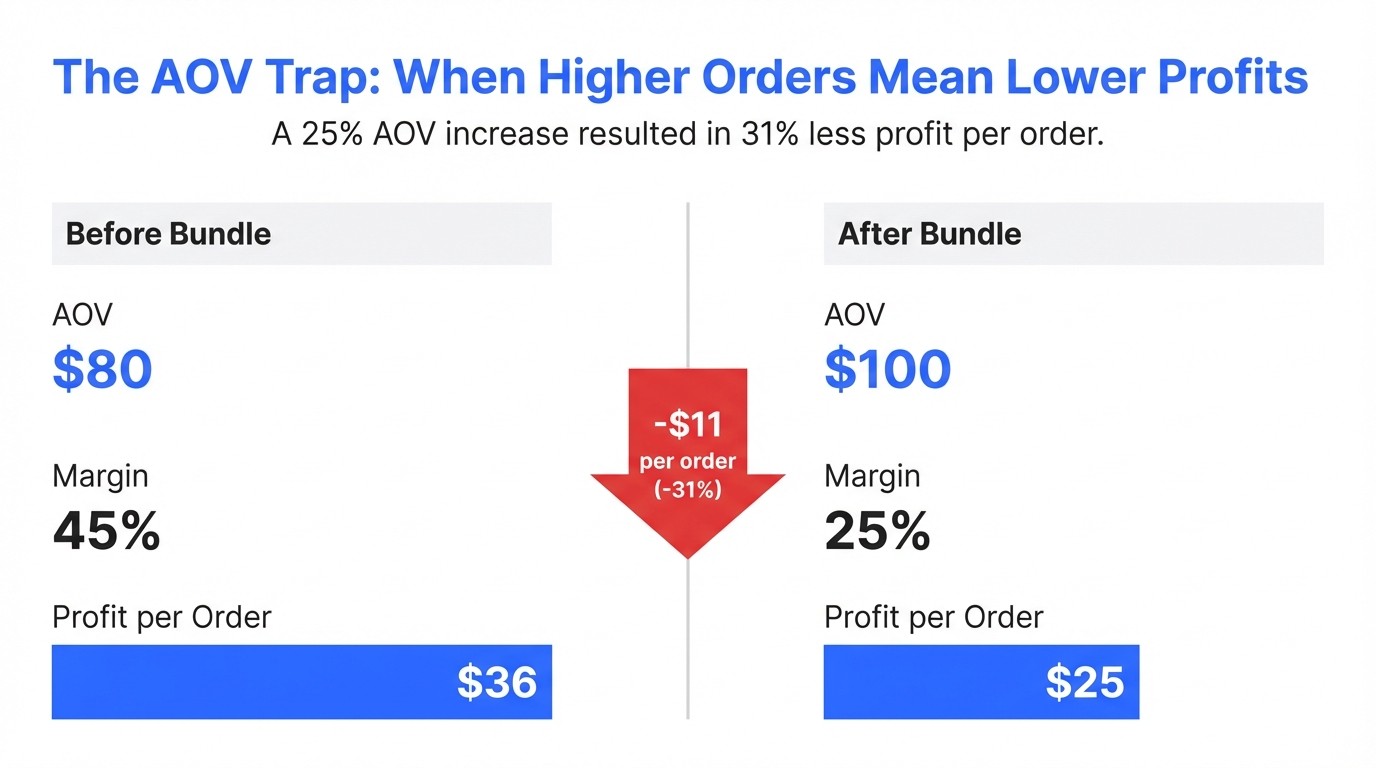
Profit per visitor accounts for all of this. It measures what you actually keep after a customer interacts with your store, factoring in conversion rate, order value, margin, and cost. When you optimize for profit per visitor instead of AOV alone, you stop chasing vanity metrics and start building a sustainable business.
What Signals in Your Data Reveal AOV Opportunities?
Your data shows where customers are ready to spend more.
Before testing any tactic, look at what your customers are already telling you through their behavior. Your Shopify analytics contain patterns that reveal genuine opportunities versus wishful thinking.
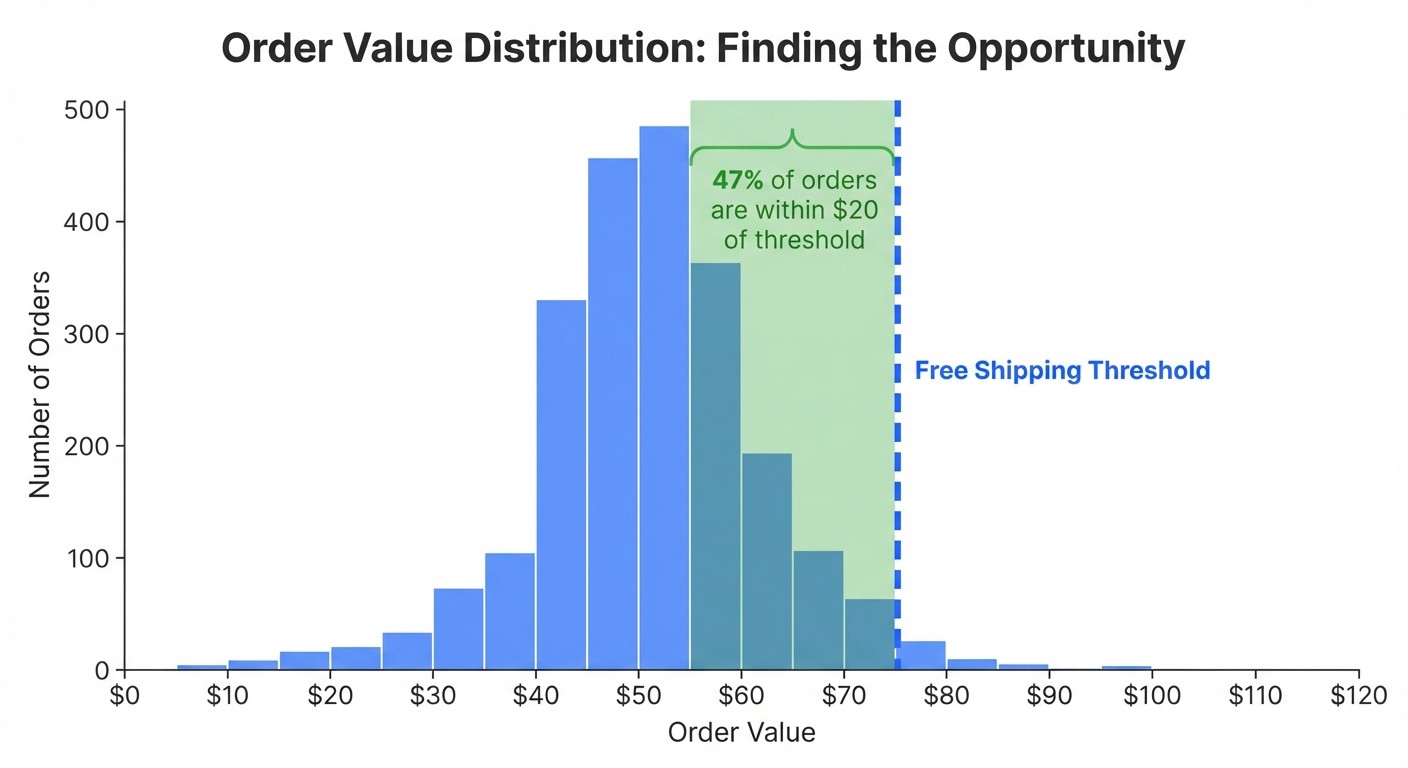
Start with your order value distribution. Pull a report from Shopify's analytics and look at where orders cluster. If you see a concentration of orders just below your free shipping threshold, customers are already motivated to reach a number. They just need a small nudge to get there. That's a real signal, not a guess.
Look at purchase patterns across orders. If the same customers frequently buy complementary items in separate transactions a few days apart, that's a bundling opportunity they're demonstrating with their wallets. They already want these products together. You're just making it easier.
Examine your multi-unit purchase data. If customers regularly buy two or three of the same item at full price, you have evidence that volume tiers could work. But if single-unit purchases dominate, a volume discount might just train customers to expect deals without actually changing behavior.
The point isn't to implement every AOV tactic you've read about. It's to match tactics to signals. Your data tells you what pricing and offers might work before you spend weeks building something customers don't want.
What Can You Actually Test?
Test the opportunity your data reveals.
Once you've identified a signal, design an experiment that measures profit per visitor, not just AOV.
If your data shows order clustering below a threshold, test adjusting your free shipping threshold to different levels. Measure not just whether AOV increases, but whether the incremental revenue exceeds the incremental shipping cost. A threshold that lifts AOV by $15 but costs you $18 in additional shipping subsidies is a losing proposition disguised as a win.
This episode reveals how one brand increased profit per visitor by nearly 10% through shipping rate optimization, showing that customers often respond better to shipping adjustments than you might expect.
If customers already buy complementary items separately, test a bundle at different price points. Start with minimal discounting to see if convenience alone drives adoption. You might discover that customers will pay close to full price for a well-curated bundle, preserving your margins while increasing order value.
If you're seeing organic multi-unit purchases, test volume tiers carefully. Run the experiment against a control group that sees standard pricing. Compare profit per visitor between groups, not just AOV. You need to know whether the discount attracts incremental volume or just subsidizes purchases that would have happened anyway. Consider whether tiered discounts or flat discounts work better for your specific customer base.
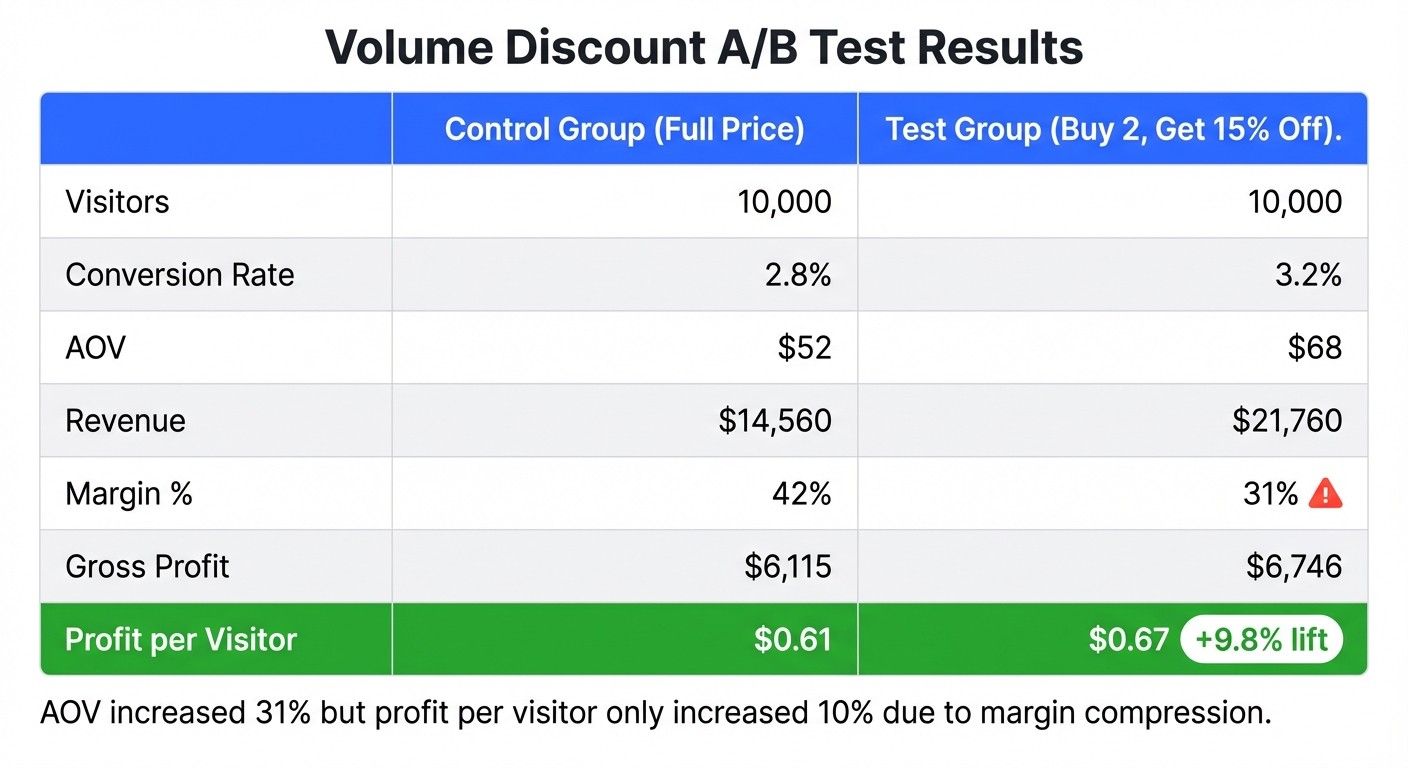
Every test should answer the same question: did this change increase what we keep per visitor, or did it just shuffle numbers around? To run these experiments properly, learn how to set up a price test that measures what actually matters.
Data from over 1,000 price tests shows that price changes create roughly 2x the conversion impact (a 5% price change typically drives a 10% conversion change). This episode explains how your margin profile determines whether raising or lowering prices will increase profit.
What Mistakes Should You Avoid?
Don't optimize for the wrong metric.
The most common AOV optimization mistake is treating the metric as the goal instead of the indicator. When teams get rewarded for lifting AOV, they find ways to lift AOV. Whether those tactics actually improve business health becomes secondary.
Aggressive upsells provide a clear example. Pop-ups that interrupt checkout, add-to-cart hijacks that confuse customers, pre-selected items that feel manipulative: these tactics can increase AOV while simultaneously increasing cart abandonment and destroying customer trust. You might see higher order values from customers who complete checkout while losing more customers who don't. If you're worried about whether raising prices will hurt your sales, testing gives you the answer without the risk.
Creating bundles customers don't actually want wastes resources and clutters your catalog. Just because two products are related doesn't mean customers want to buy them together. Let purchase data guide bundling decisions, not assumptions about what "makes sense."
Ignoring margin compression is perhaps the most dangerous mistake. Every discount, every free gift with purchase, every shipping subsidy has a cost. When you celebrate an AOV increase without calculating whether you kept more profit, you're flying blind.
How Do You Stop Guessing and Start Knowing?
Increasing average order value can absolutely improve your business. But only when the increase translates to more profit per visitor, not just bigger numbers on a dashboard.
The approach that works:
Read your data first. Look for signals that reveal where customers are already inclined to spend more.
Match tactics to signals. Test opportunities your data supports, not generic advice from articles.
Measure profit per visitor. AOV is an input. Profit per visitor is the outcome that matters.
Account for all costs. Shipping subsidies, margin compression, fulfillment complexity: include everything.
Run controlled experiments. Compare against customers who don't see the change to isolate true impact. Use experiment analytics to understand what's really driving results.
Don't guess how to improve AOV. Know.
Ready to discover what's actually driving profit for your Shopify store? When you're ready to know for sure, let's get you testing beyond what's typical.
AB Testing
AB Testing
AB Testing


