
AB Testing
How to Increase My Profits for My Shopify Store
You're asking the right question. Revenue gets the attention, but profit pays the bills.
You're asking the right question. Revenue gets the attention, but profit pays the bills.
The challenge? Profit has multiple levers, and pulling the wrong one can make things worse. You could raise prices and tank conversion. You could chase volume with deep discounts and crush your margins. You could optimize shipping but ignore what customers actually care about. Every decision affects profit, but not every decision improves it.
The path forward requires one metric that captures everything: profit per visitor. When you know how much profit each visitor generates, you can identify which lever has room to move and test changes with confidence.
What Actually Drives Profit in a Shopify Store?
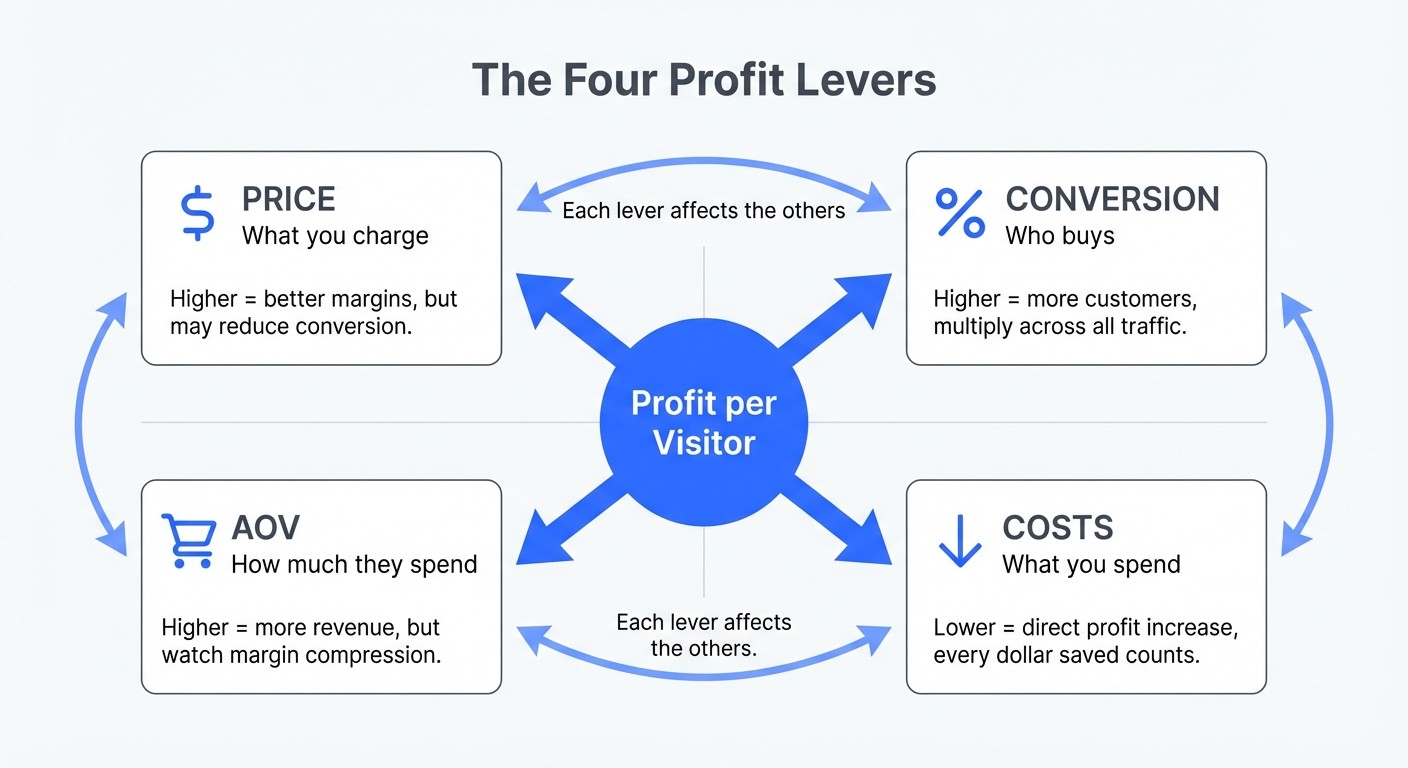
Four levers determine your profit per visitor
Profit in e-commerce comes down to a simple equation: what you earn minus what it costs, divided by how many people showed up. But that equation has four variables, and each one interacts with the others.
Price is what you charge. Raise it and margins improve, but conversion might drop. Lower it and volume might increase, but you could be leaving money on the table.
Conversion is how many visitors buy. A 2% conversion rate means 98 people leave without purchasing. Small improvements here multiply across your entire traffic base.
Average Order Value (AOV) is how much customers spend per transaction. Bundles, thresholds, and upsells can push this higher, but watch whether you're adding profit or just adding revenue.
Costs are what it takes to fulfill the order. Product costs, shipping, packaging, returns. Every dollar saved here drops straight to the bottom line. Optimizing your free shipping threshold can be one of the fastest ways to reduce shipping subsidies while maintaining conversion.
The formula: Profit per visitor = (Revenue - Costs) / Visitors
This episode explains why COGS data is essential for understanding test results. Without per-product cost data, you cannot see whether changes are actually improving your bottom line. Profit per visitor requires knowing your true costs.
Each lever affects the others. Raising prices might reduce conversion but increase margin so much that profit per visitor goes up. Lowering your free shipping threshold might boost AOV but eat into margin. You can't optimize one lever in isolation.
What Signals in Your Data Reveal Profit Opportunities?
Your data shows which lever has the most room to move
Your Shopify analytics tell a story about where profit is leaking. Reading that story requires looking at your metrics in relation to each other, not just tracking numbers in isolation.
If conversion is strong but margins are thin, pricing might be your opportunity. You're successfully getting people to buy, but each sale contributes less than it could. This pattern often shows up when discounting has become the default or when pricing hasn't been revisited in years.
If margins are healthy but conversion lags, friction is likely the culprit. Customers are interested enough to visit but something stops them from purchasing. Trust signals, checkout experience, or perceived value compared to price could all be factors.
If costs are eating your margin, operational efficiency or pricing adjustments matter. High return rates, expensive shipping, or thin product margins all show up here. Sometimes the answer is cutting costs. Sometimes it's raising prices to cover them.
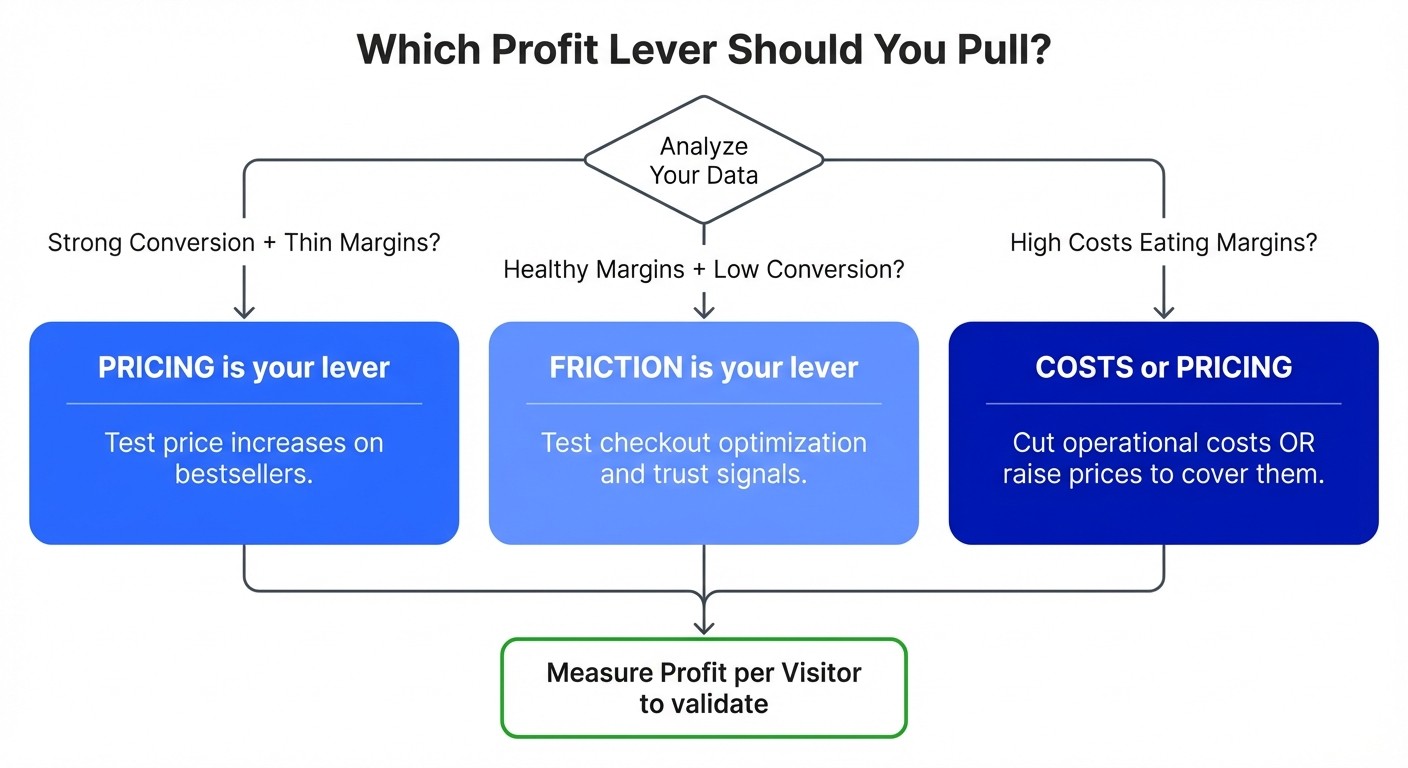
The goal isn't to pick a random lever and hope. The goal is to let your data point to the lever with the most room to move, then test whether moving it actually improves profit per visitor. To track this properly, learn how to add profit to your analytics so you can see what you're actually keeping.
This episode introduces the Explore-Experiment-Extend framework for continuous profit optimization. Rather than treating experiments as one-off events, the flywheel approach helps you find 10x improvements by testing fundamental business levers, not just stacking small 1% gains.
What Can You Actually Test?
Test the lever your data says has room to move
Once you've identified your opportunity, the question becomes: what specific change do you test?
If pricing is your lever:
Start with a straddle test. Take your current price as the control and test modest changes in both directions. If you're selling at $50, test $45 and $55. This tells you whether you have room to move up, down, or whether your current price is actually optimal. Start with your best-selling collection to get data quickly.
If conversion is your lever:
Test friction reduction. Simplify checkout flows. Add trust signals where hesitation occurs. Remove unnecessary steps. The goal is finding what builds confidence at the moment of purchase. Remember that conversion alone doesn't matter. A promotion that tanks margin to boost conversion might hurt profit per visitor even as it looks like a win.
If AOV is your lever:
Test bundles, thresholds, and strategic offers. But watch profit per visitor carefully. Pushing customers to hit a free shipping threshold only works if the margin on the additional items exceeds the shipping cost you're absorbing. A higher AOV that comes with lower margins can actually hurt profitability.
Across all tests:
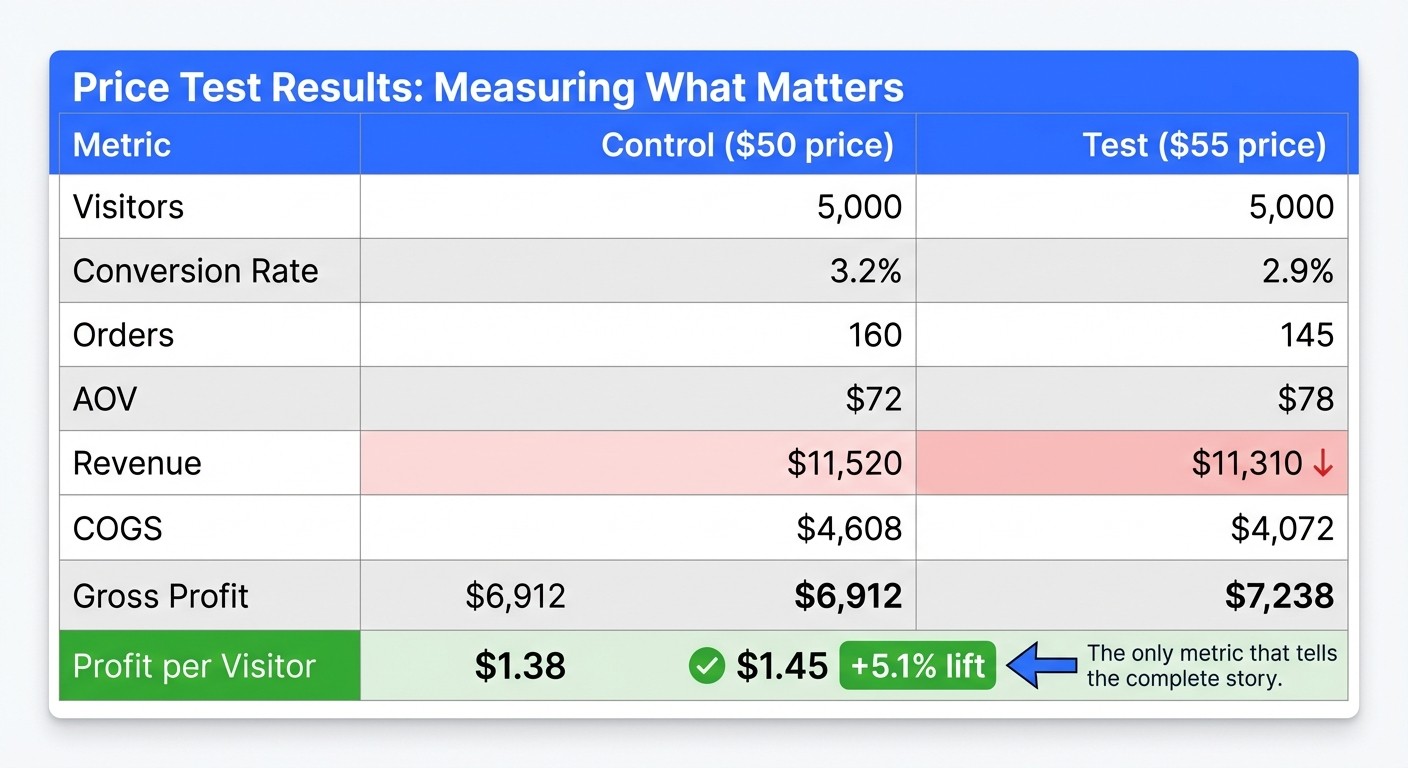
Measure profit per visitor as your North Star. Conversion rate, revenue per visitor, and AOV all matter as supporting indicators. But only profit per visitor tells you whether you're actually winning.
What Mistakes Hurt Profit Without You Noticing?
Don't optimize the wrong lever
The most common profit mistakes come from optimizing metrics that look good but don't translate to the bottom line.
Cutting prices to drive volume without checking whether increased sales offset margin loss. More orders at lower profit can mean more work for less money. Understanding how much you should discount helps you find the minimum effective discount.
Chasing conversion at any cost. Deep discounts and aggressive urgency tactics might boost conversion rates while training customers to wait for sales and eroding brand value. Test whether tiered discounts or flat discounts perform better for your margins.
Celebrating revenue growth without asking whether it came with profit growth. Revenue is vanity. Profit is sanity.
Copying competitor strategies without understanding their margins, costs, or goals. What works for their business might destroy yours.
Making changes without controlled tests. Before-and-after comparisons can't isolate what actually caused the change. Seasonality, competitor moves, and marketing shifts all muddy the picture.
The fix for all of these: test with profit per visitor as your success metric. When you measure what matters, you stop accidentally hurting yourself.
Stop Guessing. Start Knowing.
Profit improvement isn't about following a recipe of tactics. It's about understanding your specific business, reading what your data reveals, and testing changes against the right metric.
You have four levers: price, conversion, AOV, and costs. Your data tells you which one has room to move. Testing tells you whether moving it actually increases profit per visitor.
Increase your Shopify store profits:
Identify which lever your data says to pull
Run controlled tests on specific changes using common testing use cases as your starting point
Measure profit per visitor as your North Star
Let results guide your next move
Don't guess how to improve profit. Know!
Ready to discover which lever will move profit most for your Shopify store? When you're ready to know for sure, let's get you testing beyond what's typical.
AB Testing
AB Testing
AB Testing


