
AB Testing
How to Increase My Revenue for My Shopify Store
You want more revenue. Every Shopify store owner does. And there's no shortage of advice telling you to run flash sales, add upsells, or spend more on ads.
You want more revenue. Every Shopify store owner does. And there's no shortage of advice telling you to run flash sales, add upsells, or spend more on ads.
But growing revenue while shrinking profit is a losing game. You can watch your top-line number climb while your bank account tells a different story. Revenue is what you collect. Profit is what you keep. The gap between those two numbers determines whether your store survives.
The real question isn't "how do I increase revenue?" It's "how do I increase profit per visitor?" That shift in thinking changes everything about how you run your store.
Why Doesn't Revenue Alone Tell You If You're Winning?
You can grow revenue while profits shrink.
Picture this scenario: You run a 30% off sitewide sale. Orders flood in. Revenue jumps 25% compared to last month. Success, right?
Not necessarily. If your profit margin on most products was 40%, that 30% discount just ate nearly all of it. You moved more inventory, paid more in fulfillment costs, and ended up with less money than before the sale started.
This happens constantly. A store grows revenue 20% year over year while profit drops 10%. The founder celebrates the revenue milestone on social media while wondering why cash flow feels tighter than ever.
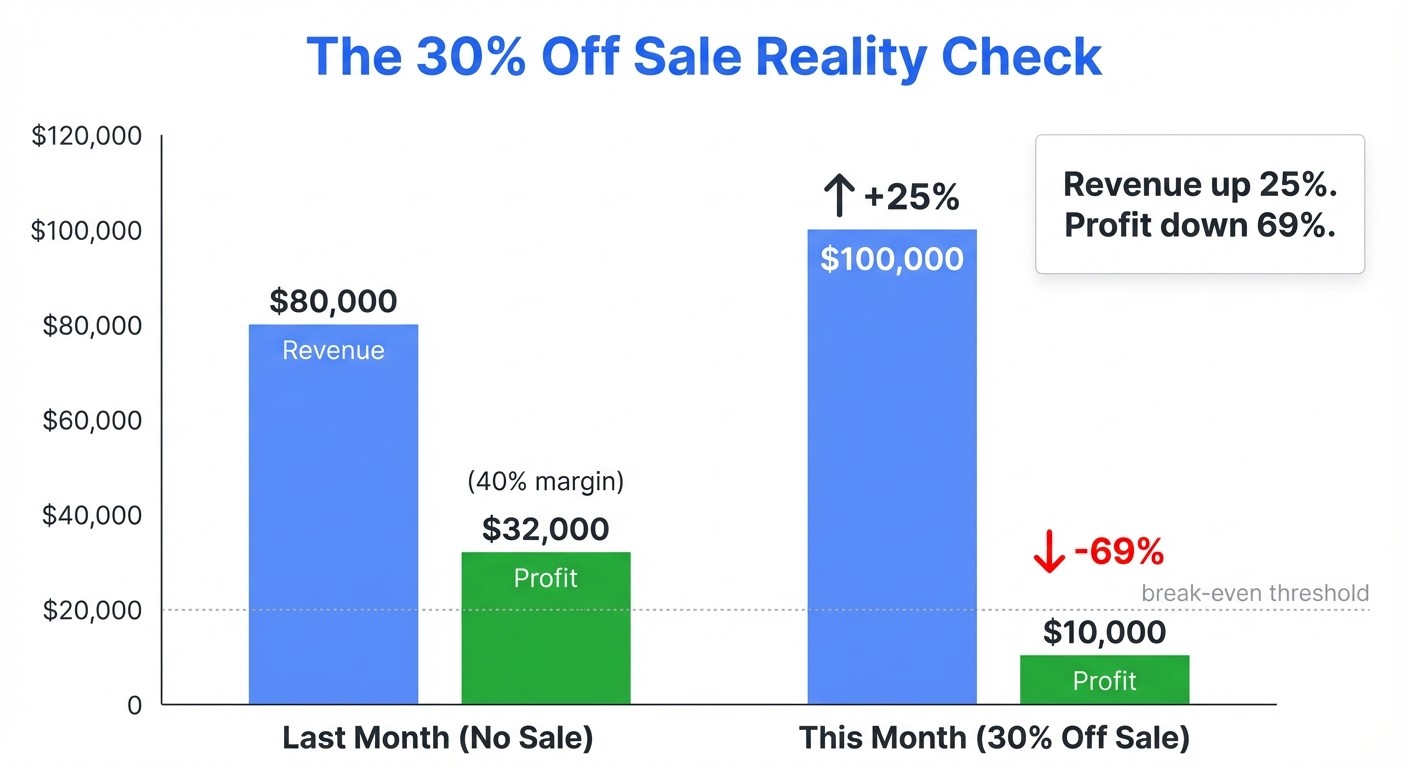
Deep discounts drive volume but destroy margin. Free shipping thresholds boost average order value but sometimes cost more than the additional revenue they generate. Paid ads scale revenue but can crater profitability when customer acquisition costs outpace lifetime value.
Based on data from over 1,000 price tests, this episode reveals that lower prices win two-thirds of the time, but your margin profile determines whether that actually increases profit. The 2x price elasticity rule (5% price change = 10% conversion change) helps you calculate the real impact.
Revenue measures activity. Profit per visitor measures efficiency. One store might generate $100,000 in monthly revenue with $10,000 in profit. Another generates $60,000 with $15,000 in profit. Which business would you rather own?
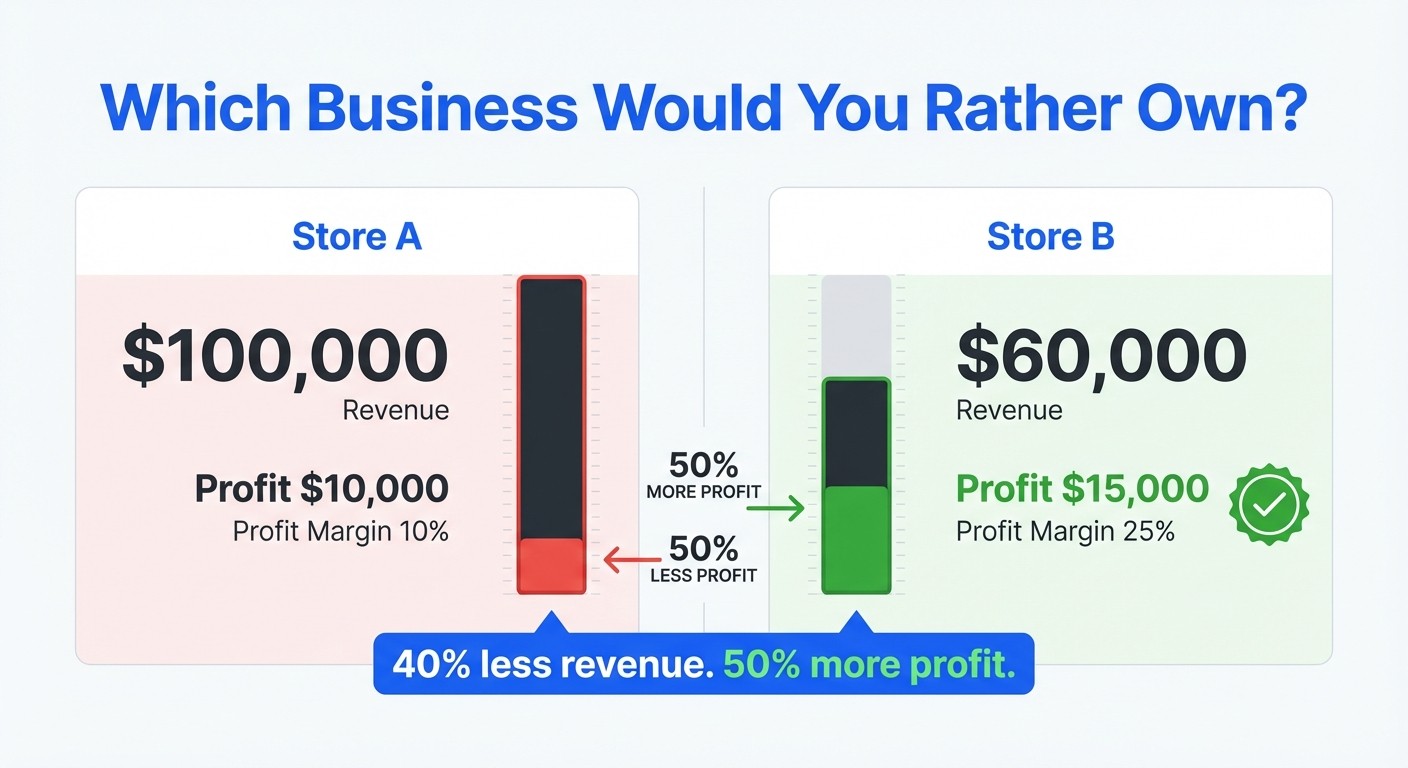
Profit per visitor becomes your North Star because it forces you to evaluate every decision through the lens of what actually matters: keeping more of what you earn.
What Signals in Your Data Reveal Revenue Opportunities?
Your data shows where profitable growth exists.
Your Shopify analytics contain signals pointing toward profitable revenue opportunities. The challenge is learning to read them.
If you're seeing strong traffic but weak conversion, that's a pricing or friction signal. Visitors are interested enough to show up, but something stops them from buying. The price might be too high relative to perceived value. The checkout might have too many steps. The product pages might lack the information customers need to feel confident.
If your highest-margin products have low visibility, that's a merchandising opportunity. Many stores bury their most profitable items while featuring lower-margin bestsellers. Reorganizing collection pages, adjusting homepage placement, or creating dedicated landing pages for high-margin products can shift the revenue mix toward profitability.
If revenue spikes during promotions but margins crater, your discounting is too deep. The goal of a promotion should be profitable volume, not volume at any cost. Understanding how much you should actually discount requires knowing your margins and testing to find the minimum effective discount that drives action.
If certain traffic sources generate revenue but those customers never return, your acquisition strategy might be attracting the wrong audience. High-volume, low-retention traffic often indicates a mismatch between ad messaging and product reality.
These signals don't prescribe solutions. They point toward where solutions might exist. Reading your data means developing hypotheses, not jumping to conclusions.
What Can You Actually Test?
Test for profitable revenue, not just revenue.
Every test should measure profit per visitor, not just revenue impact. A change that increases revenue 5% but decreases margin 8% looks like a win until you do the math.
Price optimization offers the highest leverage. Small price increases on products with inelastic demand can dramatically improve profit without reducing conversion. Small decreases on price-sensitive products can unlock volume that more than compensates for lower margins. But you won't know which products fall into which category without testing. Understanding if your prices are right requires data, not intuition. If you're uncertain about where to begin, start by identifying where to start with price testing based on your bestsellers.
This foundational episode walks through the three inputs to pricing decisions (costs, competition, and customer willingness to pay) and explains why A/B testing with a 5-10% straddle approach reveals what customers will actually pay, not what they say they'll pay.
Finding the minimum effective discount transforms promotion strategy. If a 20% discount drives the same conversion lift as a 30% discount, you've been giving away 10 points of margin for nothing. Testing discount depths reveals where customer price sensitivity actually sits.
Traffic allocation experiments help you understand which channels produce profitable customers. Not all revenue is equal. A customer acquired through organic search who returns three times is worth more than a customer acquired through a flash sale site who never comes back.
Bundle testing can increase average order value while improving margins if the bundled items have complementary cost structures. But bundles that include low-margin items alongside high-margin ones can actually reduce overall profitability despite increasing revenue per order.
The pattern across all these tests: measure what matters. Revenue is an input. Profit per visitor is the outcome.
What Mistakes Destroy Profitability While Chasing Revenue?
Don't optimize for the wrong metric.
Chasing revenue at the expense of profit is the most common and most dangerous mistake. Vanity metrics feel good in the moment. Profit keeps the business alive.
Deep discounting trains customers to wait for sales. Every time you run a promotion, you teach your audience that full price is for suckers. Over time, baseline conversion rates decline as customers learn to anticipate the next sale. You've built a business that can only function in discount mode. The fear that raising prices will hurt your sales often keeps brands trapped in this cycle when testing would reveal they have more pricing power than they think.
Celebrating revenue milestones while margins erode creates a false sense of progress. "We hit $1 million in revenue!" means nothing if you lost money getting there. The milestone worth celebrating is sustainable profitability, not arbitrary revenue thresholds.
Not segmenting revenue by profitability obscures the truth about your business. You might have products, channels, or customer segments that generate significant revenue while actually costing you money. Without segmentation, these profit drains hide inside impressive-looking top-line numbers.
Copying competitor tactics without understanding their economics leads to poor decisions. A competitor offering free shipping on all orders might have negotiated rates you don't have access to, or they might be losing money and not realize it yet.
Conclusion: Stop Guessing. Start Knowing.
Revenue growth matters. But revenue growth without profit growth is just expensive activity.
Profit per visitor is the metric that tells the truth about your business. Every pricing decision, every discount, every traffic investment should be evaluated through this lens.
Revenue is vanity. It measures activity, not success.
Profit per visitor is sanity. It measures what you actually keep.
Your data contains signals. Learn to read them before acting.
Every change should be tested. Measure profit impact, not just revenue impact. Add profit tracking to see what you're actually keeping.
Discounting has a cost. Find the minimum effective discount, not the maximum attention-grabbing one. Follow testing best practices to run experiments that give you real answers.
Don't guess how to grow revenue profitably. Know.
Ready to discover what's actually driving profit for your Shopify store? When you're ready to know for sure, let's get you testing beyond what's typical.
AB Testing
AB Testing
AB Testing


