
AB Testing
5 Experiments Supplement Brands Should Run
Supplements are built for repeat purchases. Customers consume, replenish, and return—month after month.
Supplements are a unique beast in ecommerce. Unlike fashion or home goods, your customers don't just buy once. They consume, they replenish, and (if you've done your job right) they return month after month. This consumable nature means your entire business model hinges on one critical metric: customer lifetime value.
But this is where you might be stuck. You copy competitor offers, follow industry "best practices," and hope the numbers work out. The problem? Your customers aren't their customers. Your margins aren't their margins. And your data is telling a story that generic playbooks can't read.
Winning in this space means treating your data as a compass. Every pattern in your analytics reveals an opportunity. Every friction point signals a test waiting to happen. The question isn't whether you should experiment. It's whether you're running the right experiments based on what your data is actually telling you.
Is Your Subscription Discount Actually Converting?
Your repeat purchase patterns might be stronger than your subscription uptake suggests.
Signal: You're seeing customers manually reorder every 30 to 60 days, but your subscription conversion rate remains stubbornly low. They clearly want the product regularly. They just don't want to commit to your subscription terms.
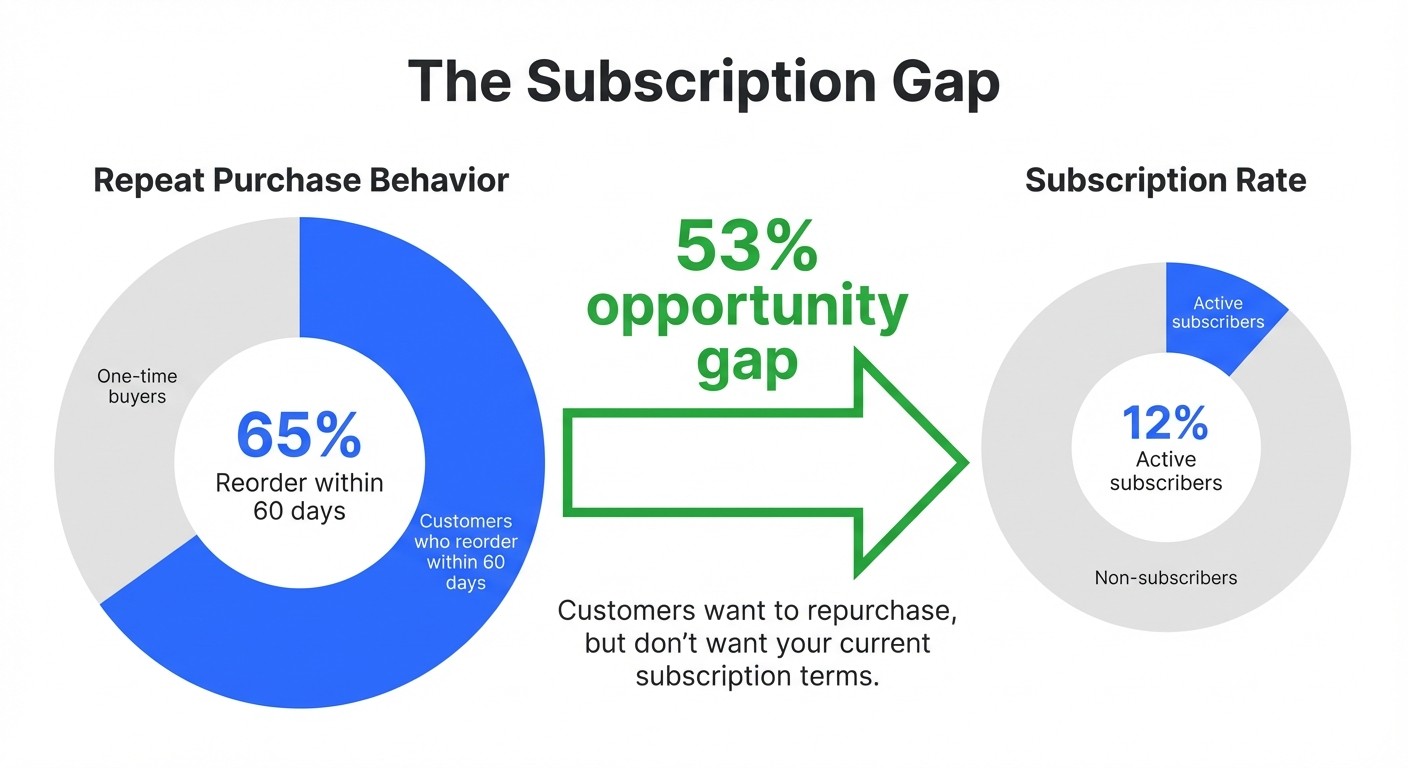
Hypothesis: This gap suggests your subscription offer isn't compelling enough to overcome the perceived risk of commitment. The discount might be too small, or the flexibility might feel too restrictive.
Test: Run a controlled experiment comparing your current subscription discount against a more aggressive offer. If you're at 10% off, test 15% or 20%. But don't stop there. Consider testing the framing: "Subscribe and save 15%" versus "Members save 15% on every order." The psychology of membership often outperforms the mechanics of subscription.
Measure: Track profit per visitor across both groups. A higher discount only wins if the increased conversion and retention outpace the margin compression. Understanding whether your current pricing structure is optimal requires looking beyond topline revenue to actual profitability. For more on structuring subscription offers, explore how to price subscription plans.
This episode dives deep into subscription experimentation, including pre-selecting subscriptions as default and testing on collection pages—with real results showing 36-40% increases in subscription take rates.
Are Customers Already Buying in Bulk at Full Price?
Multiple units per order at regular price signals untapped volume tier potential.
Signal: Your order data shows a meaningful percentage of customers purchasing two, three, or more units in a single transaction. They're paying full price for each bottle, and they're doing it voluntarily.
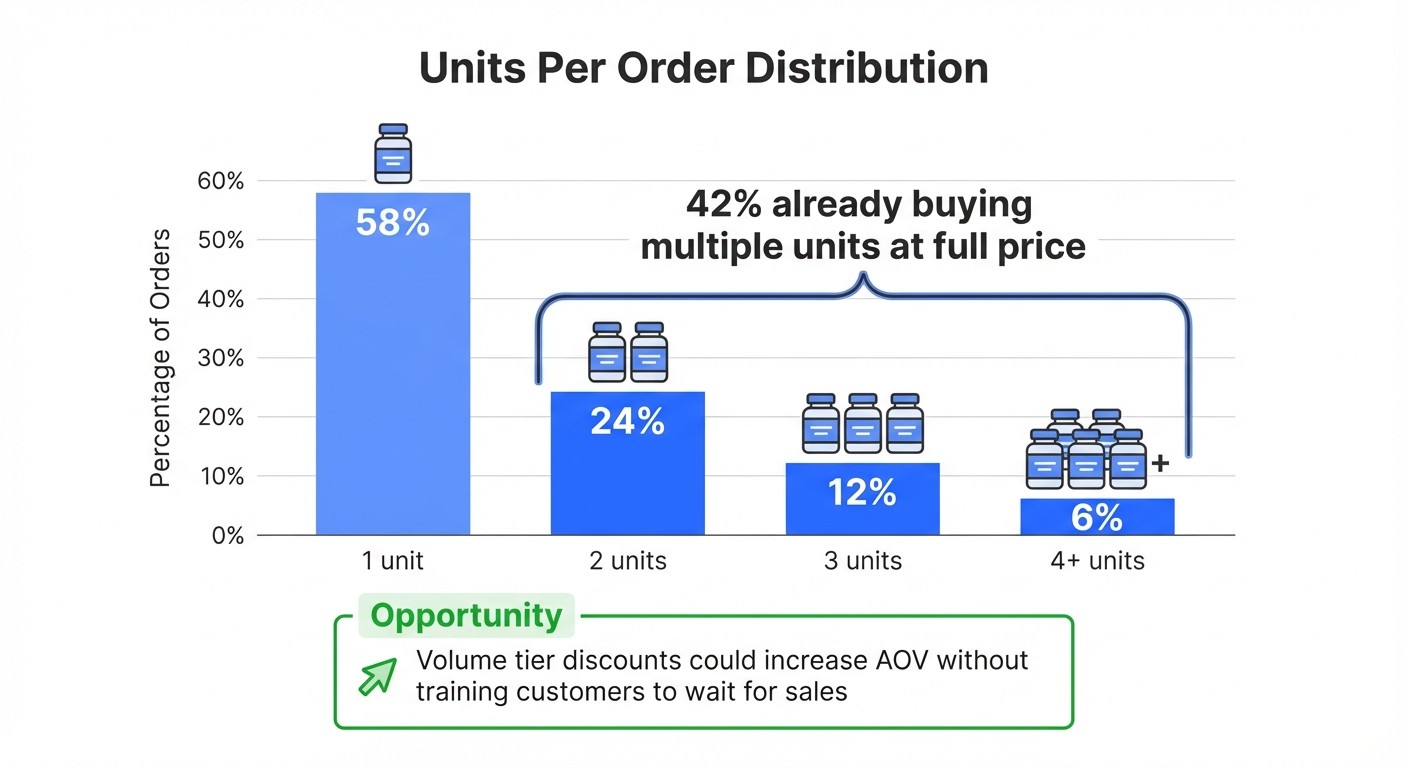
Hypothesis: These customers have already decided they want more product. They're just not being rewarded for that behavior. A volume tier structure could increase average order value while making customers feel like they're getting a deal.
Test: Experiment with tiered pricing: buy two, save 10%. Buy three, save 15%. The key is structuring tiers that encourage the next-level purchase without cannibalizing customers who would have bought more anyway. Getting the discount percentage right requires testing against your specific customer behavior, not industry benchmarks.
Measure: Compare profit per visitor between your control (no tiers) and your tiered offer. Watch for shifts in units per order and ensure the discount isn't simply training customers to wait for deals. Understanding whether tiered discounts or flat discounts perform better with your customers can guide your volume pricing strategy.
Should You Sell a 30-Day or 60-Day Supply?
Reorder timing and subscription churn patterns reveal your optimal supply duration.
Signal: You're noticing that subscription customers frequently pause or cancel around the second or third month. Or your reorder data shows customers returning at irregular intervals that don't match your product's stated supply duration.
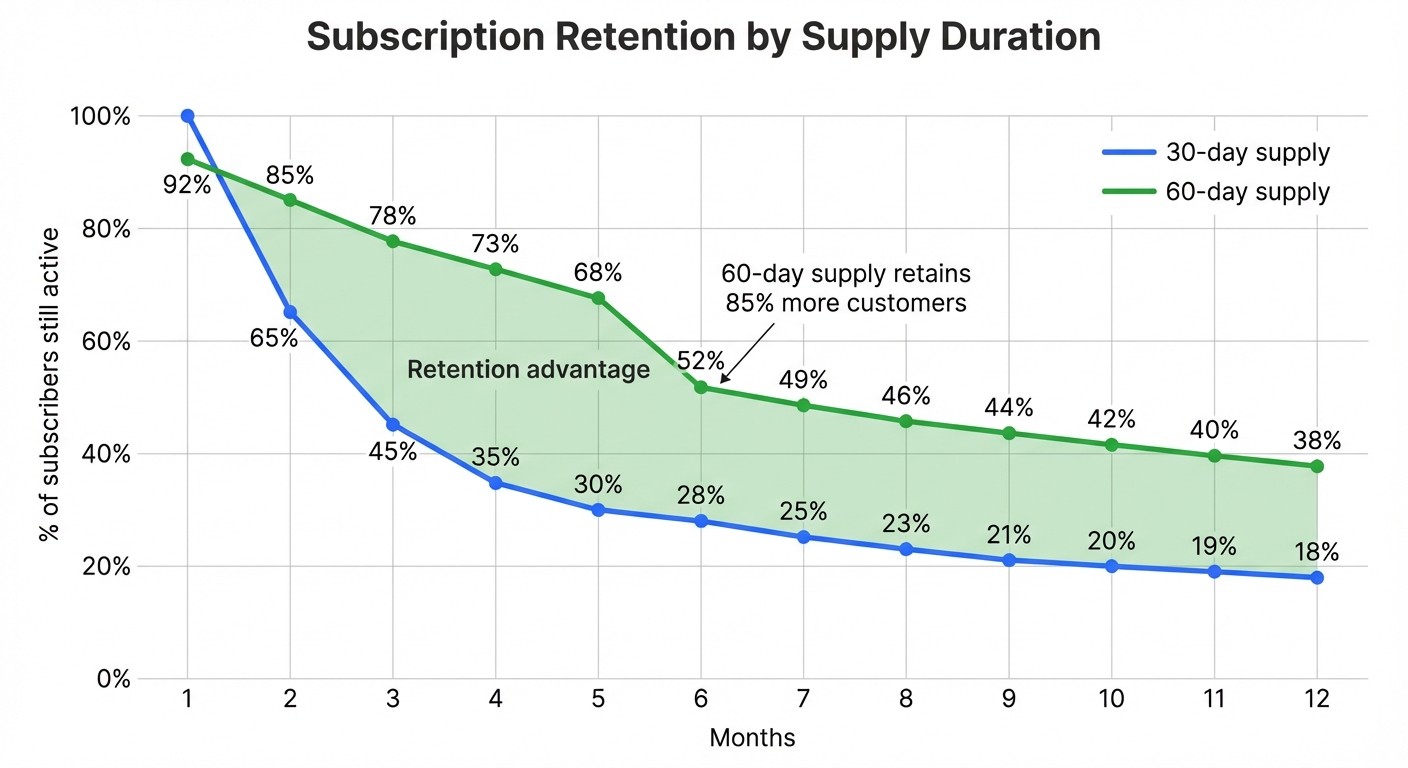
Hypothesis: Your supply sizing might be misaligned with actual consumption patterns. A 30-day supply might feel like too much commitment upfront. A 60-day supply might reduce the friction of frequent reordering but increase the barrier to first purchase.
Test: If you currently sell only 30-day supplies, test introducing a 60-day option at a slight per-unit discount. If you sell both, experiment with which you feature as the default or recommended option. The way you frame the choice matters as much as the options themselves.
Measure: Track first-order conversion rates, subscription retention curves, and overall profit per visitor. A 60-day supply might reduce initial conversion but dramatically improve retention, netting out to higher lifetime value. Your Shopify reports can help you identify these consumption patterns before you test. Learn how to set up a price test to structure this experiment properly.
Does BOGO Outperform Percentage Discounts?
Offer structure affects perceived value differently across customer segments.
Signal: You've been running percentage-off promotions, but conversion lift has been inconsistent. Or you're seeing strong response to competitor BOGO offers and wondering if you're leaving money on the table.
Hypothesis: The way a discount is framed can be more powerful than the discount itself. "Buy one, get one 50% off" and "25% off your order" can represent similar economics but trigger different psychological responses. Percentage-off versus dollar-off creates different value perceptions depending on your price point and customer expectations.
Test: Run a head-to-head experiment: one group sees a BOGO offer (buy one, get one 50% off), while the control sees an equivalent percentage discount (25% off two or more). Keep the economic value similar so you're testing the frame, not the depth of discount.
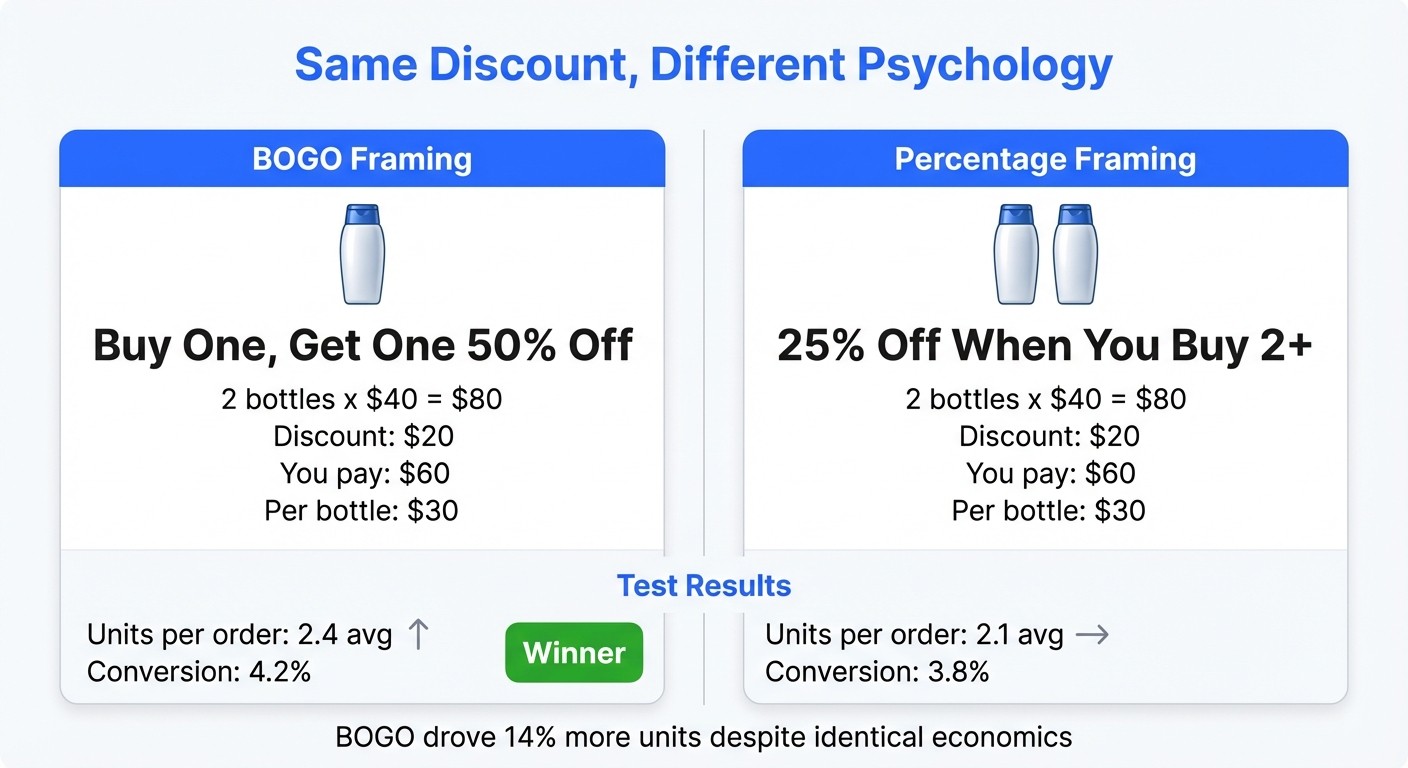
Measure: Profit per visitor remains your North Star. But also watch units per order carefully. BOGO structures often drive higher unit counts, which matters for a consumable product where more product in hand can mean higher retention.
This foundational episode explains the straddle approach to price testing and why profit per visitor is the north star metric—essential knowledge for testing offer structures like BOGO vs. percentage discounts.
Is Your First-Order Offer Pulling Its Weight?
High traffic with low first-time conversion points to offer friction, not awareness problems.
Signal: Your paid acquisition is driving traffic, but first-time purchase rates remain below benchmarks. You're paying for eyeballs that aren't converting into customers. The leak is somewhere in your offer, not your awareness.
Hypothesis: Your first-order incentive might be too weak to overcome the risk of trying a new supplement brand. Or it might be structured in a way that doesn't resonate with your specific audience.
Test: Experiment with different first-order offer structures. Test free shipping thresholds against flat discounts. Test a free sample or trial size against a percentage off. Test a money-back guarantee positioning against a discount offer. The goal is finding what reduces perceived risk most effectively for your audience.
Measure: Track profit per visitor and new customer acquisition cost together. A more aggressive first-order offer only makes sense if the customers it acquires have strong retention curves. The discount is an investment in lifetime value, not a giveaway. Review your experiment analytics to understand the full impact of your first-order offers.
Stop Guessing. Start Knowing.
Supplement brands have an advantage most ecommerce categories don't: predictable consumption creates predictable data patterns. Your customers will tell you exactly what experiments to run. You just have to know how to read the signals.
The path forward:
Let your data identify the opportunity. Repeat purchase patterns, subscription churn, units per order. These aren't just metrics. They're signals pointing to your next test.
Frame hypotheses around customer behavior. What friction exists? What value isn't being communicated? What structure might resonate better?
Measure what matters. Revenue is vanity. Profit per visitor is sanity. Every experiment should be evaluated against its impact on sustainable profitability.
Iterate based on evidence. One test gives you an answer. A testing program gives you a competitive advantage.
Dominating your category doesn't require the biggest budget. It requires treating experimentation as a core competency. Every assumption is a hypothesis waiting to be validated.
Ready to discover what experiments will move the needle for your supplement brand? When you're ready to let your data guide your testing, let's get you testing beyond what's typical.
AB Testing
AB Testing
AB Testing


