
AB Testing
Can I Run Multiple A/B Tests at the Same Time?
Testing calendars tend to freeze the moment two experiments might overlap. Here's why that instinct costs more than it protects, and the handful of cases where it's actually right.

Carlos Trujillo

Running two tests on the same store at the same time means some visitors land in both, and that feels risky. If someone sees two different changes at once, an easy worry is that you won't be able to tell which one caused what happens next, so the safe-feeling move seems like pausing everything except one experiment at a time. That worry has a name: an interaction effect, and it's rarer than it feels.
The real cost isn't the rare interaction. It's the test you held back while you waited: a week or a month where you learned nothing new about what actually moves your customers. Two live tests only really distort each other's results when they're pulling on the same lever, the same element, the same moment, the same decision a customer is making. Here's how to tell which situation you're actually in.
It's Not About How Many Tests Are Live. It's About What They Touch.
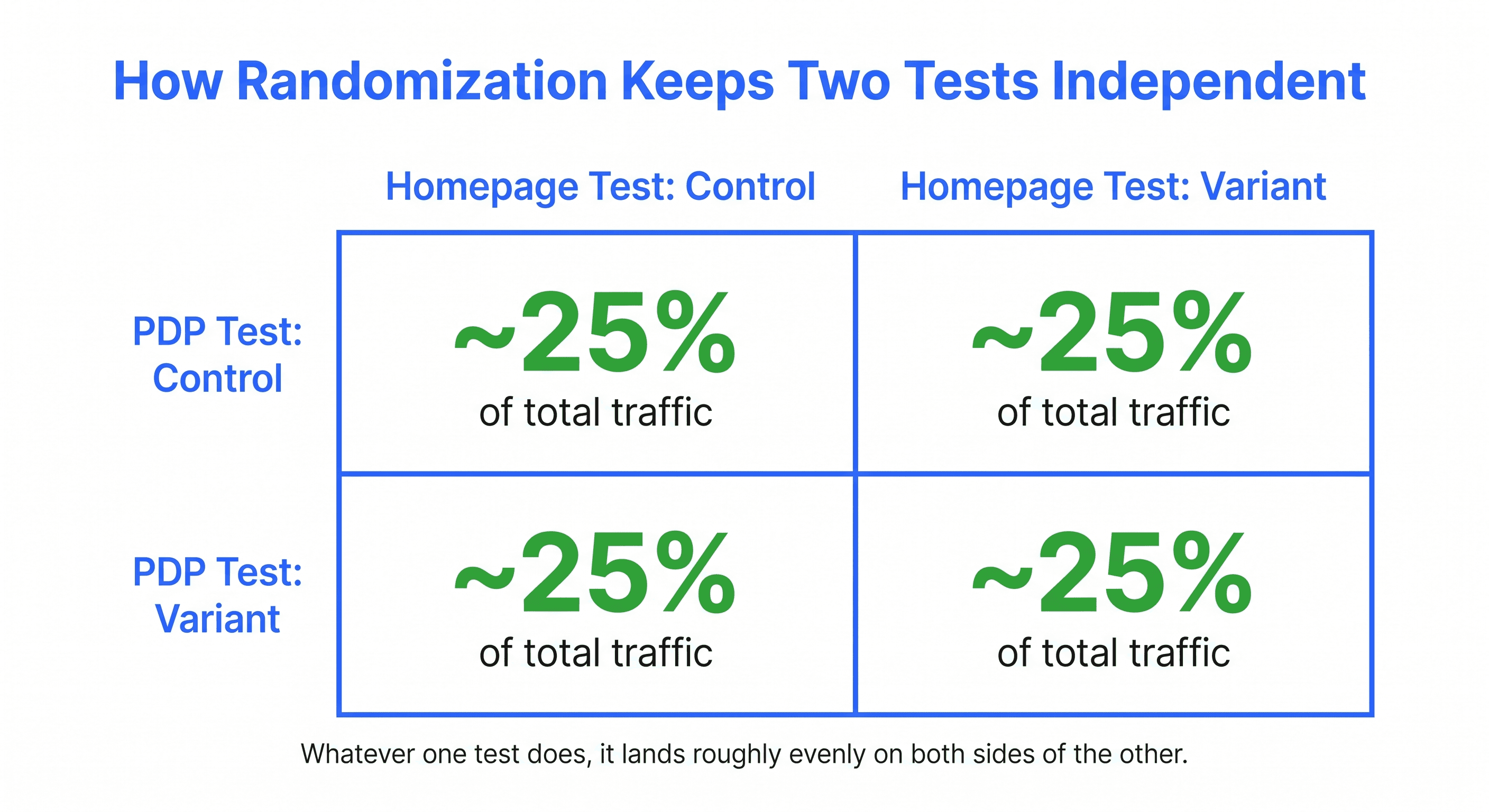
Say you're running a homepage hero banner test while also testing a new size guide on your PDP. Some visitors will hit both. That sounds like a recipe for messy results, but it usually isn't, and the reason comes down to one thing: randomization.
Your homepage test is splitting visitors 50/50 completely at random, and so is your PDP test. Neither split knows the other exists, so the mix of shoppers who saw the new size guide ends up basically the same on both sides of your homepage test. Randomization already did the isolating for you, before you did anything else, so whatever the size guide is doing to behavior cancels out of the one number you're actually watching.
Randomization is the reason two tests can share the same traffic without stepping on each other. It only breaks down when they're competing for the same decision. A checkout upsell test and a gift-with-purchase progress bar test are both trying to get the customer to add more before checking out, two angles on one purchase decision rather than two independent tests. Run those blind and if your numbers move, you won't know which one actually did it.
That's the exception, though, not the rule. The broader instinct to keep every test walled off comes from a place that doesn't quite apply to your store. Academic trials isolate everything because a wrong call gets published and can't be quietly walked back.
A Shopify test isn't a clinical trial. If two tests turn out to produce a real interaction effect, you'll see it in your dashboard, not a journal, and you can fix it the same day.
Where This Shows Up at Real Testing Volume
Tim Davidson, who runs a Shopify CRO agency, shares what running concurrent tests has done for his clients.
"The best thing about Intelligems is the model of randomized participation, because it means we theoretically run as many parallel onsite tests as we want without diluting the traffic. Without this approach, there's no way we'd be able to run as many tests as we are right now." —Tim Davidson
More on why waiting for the perfectly isolated testing setup usually costs more than the overlap risk it's avoiding.
When to Actually Isolate Two Tests
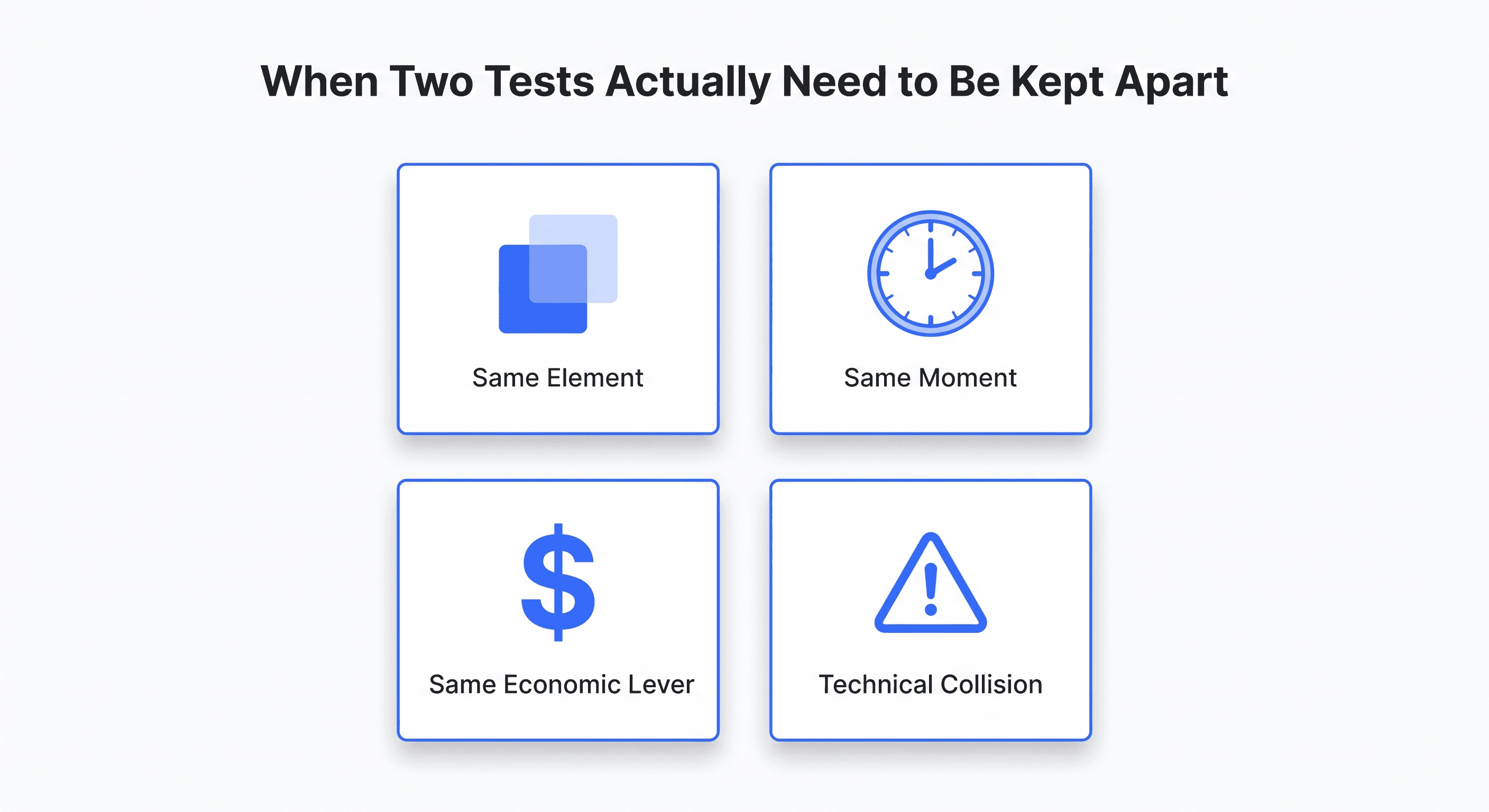
A few situations genuinely call for keeping two tests apart:
They're touching the same thing. A button-color test and a button-copy test on the same button aren't two experiments. They're four unlabeled variants of one.
They're fighting for the same moment. A checkout upsell test and a gift-with-purchase progress bar test are both trying to get the customer to add more before checking out.
They're pulling the same economic lever. A free-shipping-threshold test and a discount-depth test both change how much a customer ends up paying to check out. Run them together blind and you lose the ability to tell which one moved your profit per visitor.
They can break each other technically, not just statistically. A sticky announcement bar test and a navigation menu test might not touch the same decision at all, but if one pushes content down right as the other expects a fixed position, you get a rendering bug instead of a clean read.
Even inside those categories, you don't have to choose between running two tests together blind or shelving one until the other wraps up. A simple middle ground is a staggered start.
If a PDP test and a checkout test both touch the same purchase decision, launch one this week and the second next week instead of both on day one. You're still testing at close to full speed. You're just not asking your data to untangle two brand-new variables that showed up on the same page on the exact same day.
More experienced teams often skip the stagger too. If a PDP reviews-widget test and a PDP shipping-estimate test touch genuinely separate parts of the page, with no shared element and no shared moment, running both from day one is fine. The caution scales with how isolated the changes actually are, not with how many tests happen to be live on the same page.
Outside of those, a PDP photo test and a loyalty-program signup nudge, or a homepage hero test and a post-purchase upsell test, can run in parallel without a second thought. They're not reaching for the same customer decision.
The Research, If You Want the Receipts
None of this is just a hunch. Microsoft's own experimentation team looked at it directly across four major products, running hundreds of concurrent tests on millions of shoppers without keeping any of them apart. Three of the four products showed zero measurable interaction effect between test pairs. The fourth found one in roughly every 50,000 test-pair comparisons it ran. They titled the write-up "A Call to Relax", which says a lot about how big a deal this actually turned out to be.
Ron Kohavi, who ran experimentation at Bing and Airbnb, has made the same point for years: real interaction effects come up far less often than testing teams assume. Treating every live test as a threat to every other one trades real learning for protection against a risk that rarely shows up.
When You Want More Certainty Than That
If two live tests share a lever you're not sure about, the honest answer is you probably don't need to lose sleep over it. The research above already says it's fine, and agencies and large brands running hundreds of tests a year lean on that same logic every day. Save the real caution for the cases already covered: same element, same moment, same economic lever, or a technical collision.
For the rare pair that needs a harder guarantee than a staggered start, most testing tools, Intelligems included, let you flag two tests as mutually exclusive so a visitor only ever lands in one. That buys certainty. It also costs you something.
Whatever moves, you know which test moved it, but splitting one visitor pool across two tests means both take longer to read. You still never learn how the two would have interacted, you just avoid finding out. Save it for the pairs that actually need it, not as a setting you flip for your whole calendar.
The real question before you launch a new test was never "is something else live." It's "does that something else want the same customer decision." Get that right, and most of your testing calendar can run in parallel instead of queuing behind one experiment at a time.
There's no single recipe for how much caution any of this needs. That depends on your traffic, your team, and how much certainty a given decision requires. Generally speaking, though, testing velocity is worth the risk.
The interaction effect you're avoiding by waiting is rare. The learning you give up by waiting is guaranteed.
Content Testing
Expert Guide
Ecommerce Strategy


