
AB Testing
5 experiments you can still run before Black Friday
Not every test can read in time.

With days left before site changes stop, the tests worth starting are those that read in time and settle a decision you keep all season. Your offer’s depth and kind can read fast on a sale before Black Friday, if you run one; a group’s own offer reads slower, and a landing page or threshold change needs ordinary traffic.
The easy default is to call testing over, or to start a long test and read it early; either way, a guess sets the season.
A read on few orders is noise
Your offer is mostly set, and your team stops site changes in a few days. Any test you start now needs enough orders before Black Friday, because a difference on a small sample is mostly noise.
Because weekday and weekend shoppers behave differently, one Intelligems growth-experimentation lead’s practice is to give every test at least a full week. Say one ordinary week is left and your test has two groups. At the 300 or more orders per group that Intelligems’ docs recommend, that week needs at least 600, or the test cannot read in time.
What fits now is offer tests on an earlier sale, ordinary-traffic tests where your orders allow, and choices you lock for the season.

Extra depth either moves shoppers or only spends margin
What a depth test answers is whether an extra step of discount moves your shoppers or only spends your margin. If you run a sale before Black Friday, a test there can give at least a directional read.
That read informs how deep to go: the smallest offer that still changes what your shoppers do. The cost sits in the deeper group, which spends margin wherever the extra depth changes nothing. Depth needs lead time, so it is decided before the season.
The same value can land differently as another offer
The same value can draw a different response as a free gift or free shipping instead of your percent off.
Picture a test on an earlier sale: your planned percent off against a free gift on orders above a set spend, both shown the same way. Equal visibility matters, because an offer shoppers cannot see leaves their behavior unchanged.
The cost: an offer type your shoppers do not see all year is harder for them to compare with your everyday offer. A new mechanism needs lead time, too.
A group’s own offer buys fit but reads slower
Giving one group of shoppers, or one group of products, its own offer buys fit. The same offer can be worth more to a shopper who already knows your product, and products differ in margin, stock and shipping.
That offer needs its own control inside the group, so it reads only on that group’s orders. One test on everyone reads sooner, and you can still break its results out by group afterward.
So that offer fits your days left only when the group can fill both versions on an earlier sale.
One ad’s page has only that ad’s clicks
A page built for one ad reads in the days before your sale only if that ad sends enough clicks to fill both versions. Otherwise, you lock the page choice on what you know.
Sale messaging adds noise to a landing read, so it needs normal traffic, which ends when your sale starts. A dedicated page matches what your ad promised, at the cost of building and keeping it up for each campaign.
Your threshold meets smaller carts during a sale
In a sale, a free-shipping threshold counting the discounted cart, as Shopify’s does, meets smaller carts. Check where discounted orders land against it. A change earns a test only if ordinary days fill both groups; otherwise, it is decided for the season. Lowering the bar pays shipping on orders that would convert anyway; holding it asks sale shoppers for more.
Tests that can’t finish become decisions
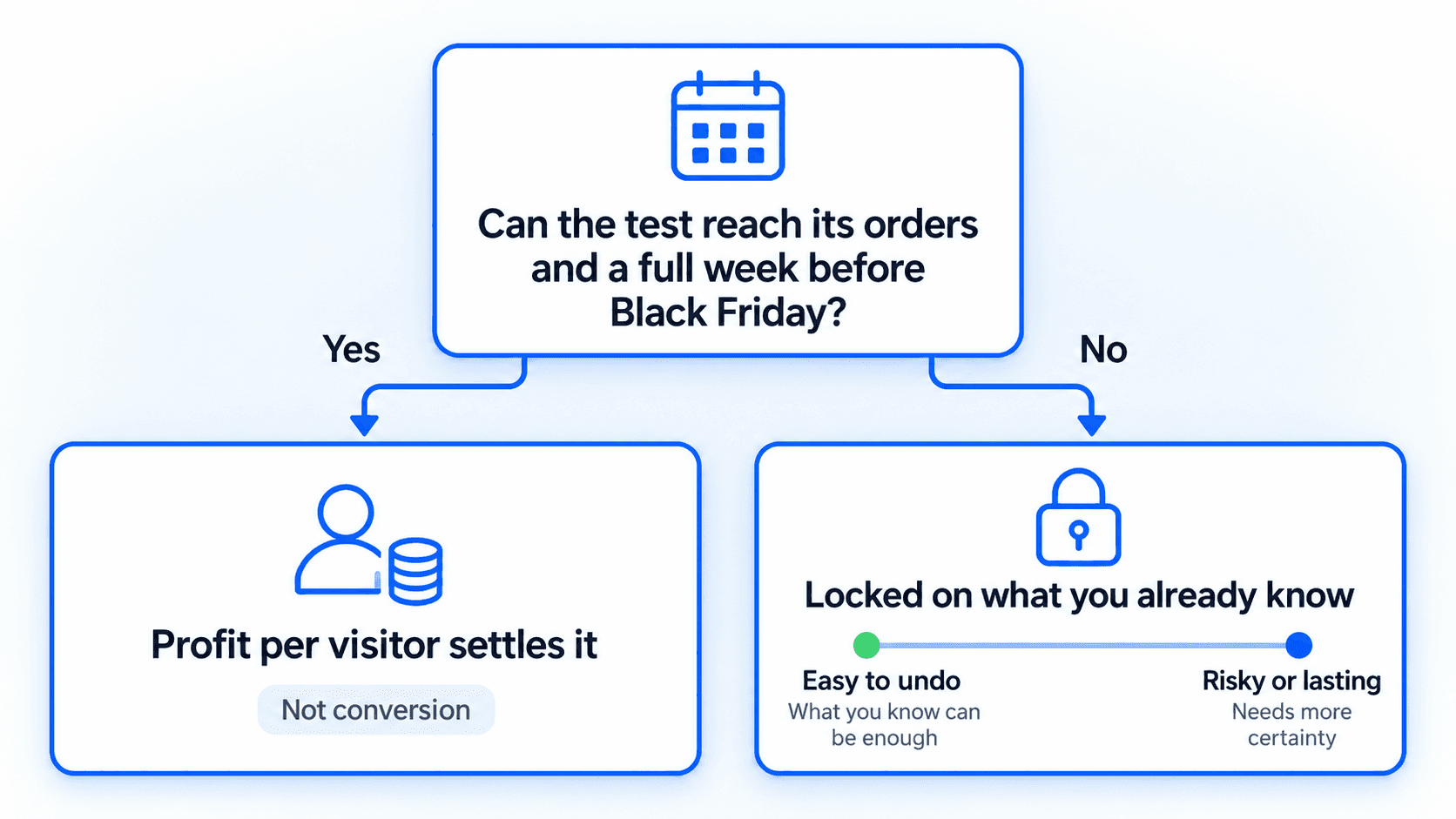
A choice whose test cannot reach its orders and a full week before Black Friday is locked on what you already know. With no sale before Black Friday to read on, the three offer tests above become decisions too. What you know can be enough for an easy-to-undo change; a risky or lasting one needs more certainty.
For the tests that do read, profit per visitor settles them. A sale lifts conversion almost whatever you change, so a deeper offer can win on conversion and lose on profit per visitor.
An Intelligems co-founder weighs waiting for more confidence against acting sooner, using doors you can and cannot walk back through; the discussion starts at 15:10.
Start one or two before site changes stop
A test you set up before site changes stop can still read on an earlier sale.
The decision, in four moves:
Count your orders in a normal week and in a sale week, split across the groups a test needs.
Pick the one or two offer decisions you most need settled, and set them up to read on an earlier sale, if you run one.
Check discounted orders against your free-shipping bar, and test a change to it or a landing page only if ordinary days can fill both groups.
Read profit per visitor, not conversion, and weigh anything unread by its risk and how easily you could undo it.
If that counting sounds like work, Claude connected to the Intelligems MCP can pull the numbers. Ask it: “Show my total orders for the last 30 days and for my last sale’s dates, and list my running tests’ orders per group.”
What works depends on your shoppers, so strong brands treat any list of tests as ideas their own test settles. Intelligems can help you design those tests on an earlier sale and read the results; its before-sale checklist covers what else to lock in before the season.
AB Testing
Discounts
Campaigns


