Discounts
What can I offer for Black Friday instead of percent off?
Each offer spends margin in its own way.

Gifts, free shipping and buy-more deals give shoppers something other than one number off the price, which makes Black Friday harder to compare with your everyday offer. In Intelligems’ look at 3,000+ Shopify brands’ Labor Day 2026 weekend, percent off still led at 64%, down from 69% in 2025, as gifts and free shipping gained share.
Percent off is the easy default because shoppers read it at a glance; that clarity is also its cost.
A straight discount costs exactly what shoppers see
Your Black Friday sale is set at a percent off, the offer shoppers expect from a holiday sale. It is simple to run and reads the same at every price in your store. Percent off led over the Labor Day 2026 weekend, but that mix counts what brands ran on a different holiday and says nothing about what paid off.
What your shoppers see is exactly what you pay: the full saving, on every discounted order. So the question becomes where else your margin could go.
Harder to compare cuts both ways
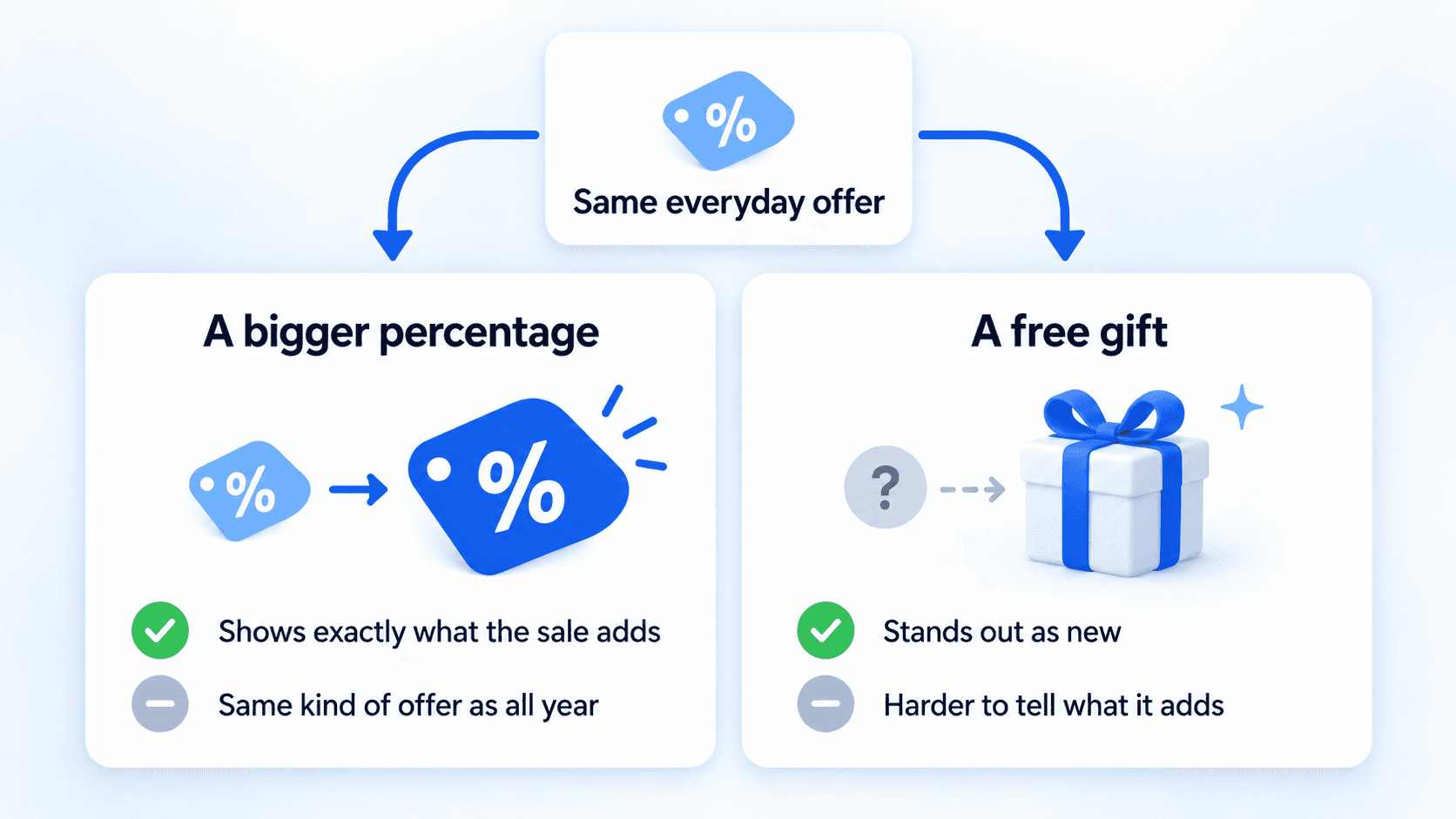
A kind of offer you don’t run all year can stand out as new, and it lets you step outside raising your percentage at every sale. The trade is clarity: a different kind of offer makes it harder for shoppers to tell what Black Friday adds to what they already get.
Say your shoppers get 25% off every day and Black Friday brings three free gifts on orders over $50: what did the sale add?
Each alternative spends margin in a different place
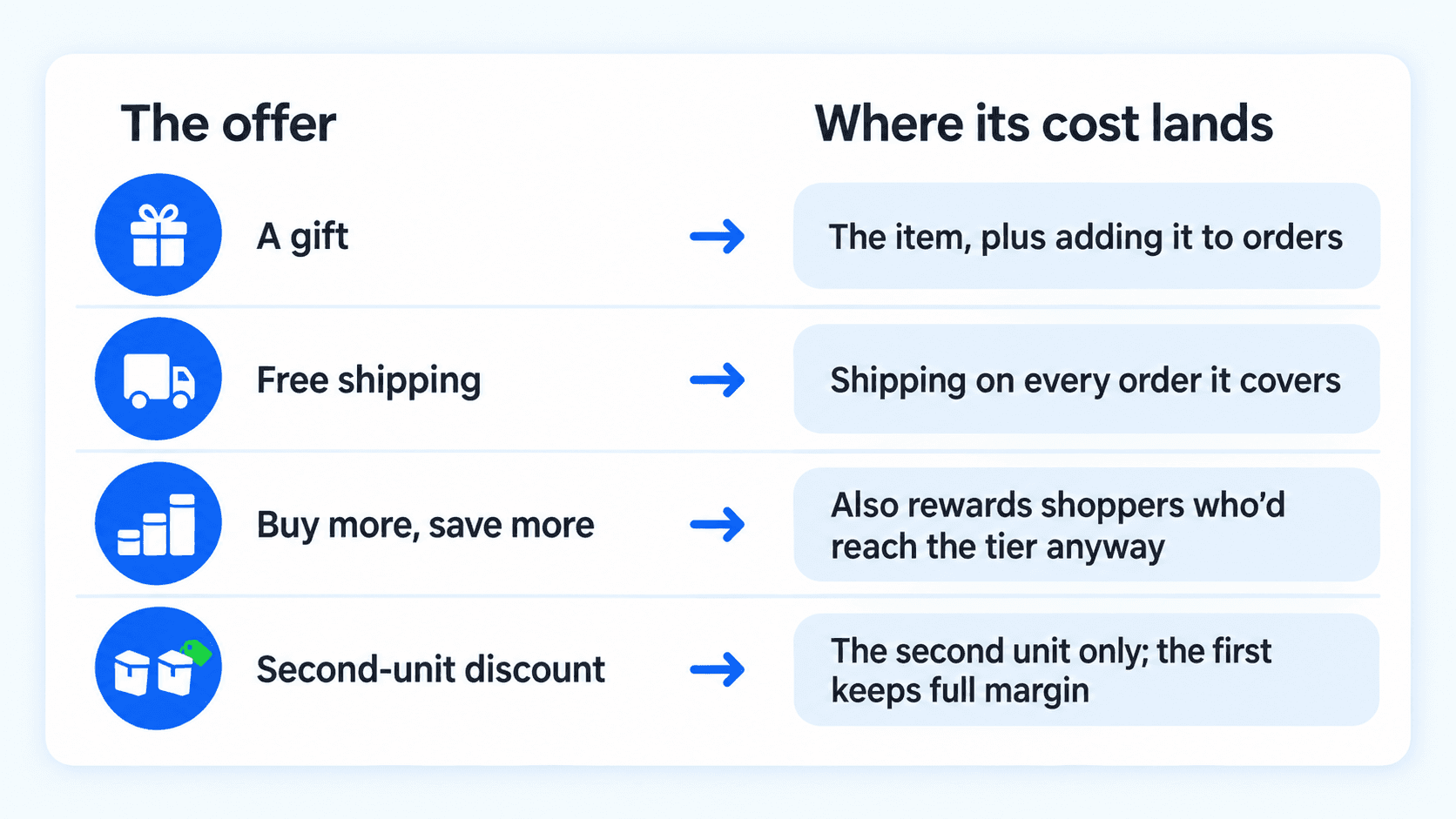
Every offer gives up margin; what changes is where the cost lands and which shoppers it reaches.
A gift costs the item plus the work of adding it to orders, and it pays off only if shoppers value it.
Free shipping absorbs the shipping on every order it covers, even orders that would have paid it.
Buy more, save more aims at a bigger basket without a sitewide markdown, but it also rewards shoppers who would have reached the tier anyway.
A second-unit discount keeps the first unit at full margin and fits shoppers buying one to give and one to keep.
Say a shopper buys one item: a sitewide percent off gives them the full saving, while buy one, get one half off gives them nothing.
The behavior you’re paying for picks the offer
Buying now points to a percent off, buying more to a buy-more deal and buying gifts to a second-unit discount.
If the widest reach matters most, a percent off suits it, at the full saving.
If margin matters most, a gift worth more to shoppers than it costs you fits, at the risk it feels cheap.
If a bigger basket is the goal, buy more, save more fits, at the cost of rewarding shoppers already past the tier.
If gift buyers are your audience, a second-unit discount fits, with nothing extra for one-item shoppers.
If late-season delivery worry holds shoppers back, fast free shipping answers it, at that shipping cost on every order.
Who your shoppers are shifts the fit: price- or value-sensitive, one-time or repeat, buying for themselves or as gifts. So does your stock: hero products you keep at full price, or excess you need to clear.
An Intelligems team member maps sale goals to offers with worked examples, then lists questions on margins, shoppers, stock and competition; the walkthrough starts at 0:44.
Order value can rise while profit falls
An alternative’s cost comes off each order it touches. That means a bigger basket can still earn you less.
Profit per visitor settles the choice because it counts revenue, product cost and the offer’s cost across every visitor. Order value and the share of shoppers who take the offer are tempting, but both can climb while profit falls.
An offer that needs a calculator adds friction
Being harder to compare helps only while the deal stays easy to understand and claim. Tiers that need arithmetic and thresholds that don’t match how your shoppers buy add friction. So does a next tier hidden until checkout, or a gift shoppers must find and add themselves.
Test one alternative against your planned discount
A new kind of offer needs time to try, and an earlier sale gives you that time. Your decision comes down to four moves.
Name the behavior your sale is paying for.
Pick one alternative whose cost fits that behavior and that shoppers can read and claim at a glance.
Run it against your planned discount on a sale before Black Friday.
Read profit per visitor, not order value or how many shoppers took the offer.
If pulling your own numbers sounds like work, Claude connected to the Intelligems MCP can do it. Ask it: “Show my order value distribution and units per order for the last 90 days, list my offers, and show profit per visitor for each variation of my completed tests, if my product costs are set up.”
What works depends on your shoppers, so strong brands judge an alternative by their own test, not by what other stores ran. Intelligems can help you design your test and read the result, and its Black Friday planning hub lays out more before-sale ideas to try.
Discounts
Campaigns
Ecommerce Strategy