
Does A/B Testing Hurt Paid Channels? We Analyzed 157 Tests Across 170M+ Visits to Find Out
AB Testing
Does A/B Testing Hurt Paid Channels? We Analyzed 157 Tests Across 170M+ Visits to Find Out
Four separate checks for a paid-channel effect... traffic levels, dose-response, control-group conversion, and the most invasive test types. Here's what the data showed, and how to run the check on your own store.

The worry is fair and common. You run a test, watch CAC or CPMs tick up a day later, and the test is the easy thing to blame. So instead of debating it, we looked. Our data science team ran a platform-wide study across Intelligems... 157 clean A/B test launches, 69 brands, 170 million visits this year... and ran four separate checks for a systematic effect on paid channels. There wasn't one. Paid traffic showed no bias in either direction around a launch, and it behaved just like unpaid channels. Here's what we found, and how to check your own store.
Why the Fear Is Understandable
Paid metrics are noisy, and a test is often the newest thing you changed, so it draws the blame. There's also a real, mechanical reason CAC can climb during a winning test. It's a cost-per-order number, so trading a little conversion rate for higher order value pushes it up even when the test is working.
We unpack that math, and the day-to-day noise behind most CAC scares, in Why Does My CAC Go Up When I Run A/B Tests? That post answers the one-test, one-store version of the question. This one answers the bigger one: across many tests and many stores, is there a systematic effect? For that, you need data.
How We Checked
This wasn't a spot-check on one store. We looked platform-wide, and only at clean launches... ones with no other test running in the surrounding weeks, so the period before each launch is a fair baseline. The goal wasn't a story from one brand. It was to see whether a consistent bias shows up across the whole platform, the kind of pattern that would repeat again and again if testing really did tax paid channels.
These are all live, transactional Shopify stores, real merchants processing real orders. So the study runs on financial data, not just clicks... real conversion and revenue by channel, not only pageviews.
The logic that makes the check trustworthy is simple. Organic and direct traffic don't run through an ad auction. Nothing decides what to charge you to reach those visitors. So if testing were quietly taxing paid traffic, paid should move differently from organic and direct. Your unpaid channels act as a natural control group.
From there we ran four checks, each coming at the question from a different angle, plus placebo runs on no-launch dates and a stricter two-week window to confirm the result held.
Check 1: Does Paid Traffic Drop After a Launch?
For every clean launch we measured the before-and-after change in daily traffic for each channel, then looked at how those changes spread across all the launches. If testing systematically hurt paid channels, Paid Social would pile up on the negative side.
It didn't. All three channels... Paid Social, Paid Search, and Organic plus Direct... form a bell centered on zero, with each median sitting essentially at no change (Paid Social +0%, Paid Search -2%, Organic plus Direct -1%). A launch is about as likely to be followed by a small rise as a small fall. The average even flips sign depending on the window you pick, which is exactly what noise looks like. Paid behaves just like the unpaid baseline.
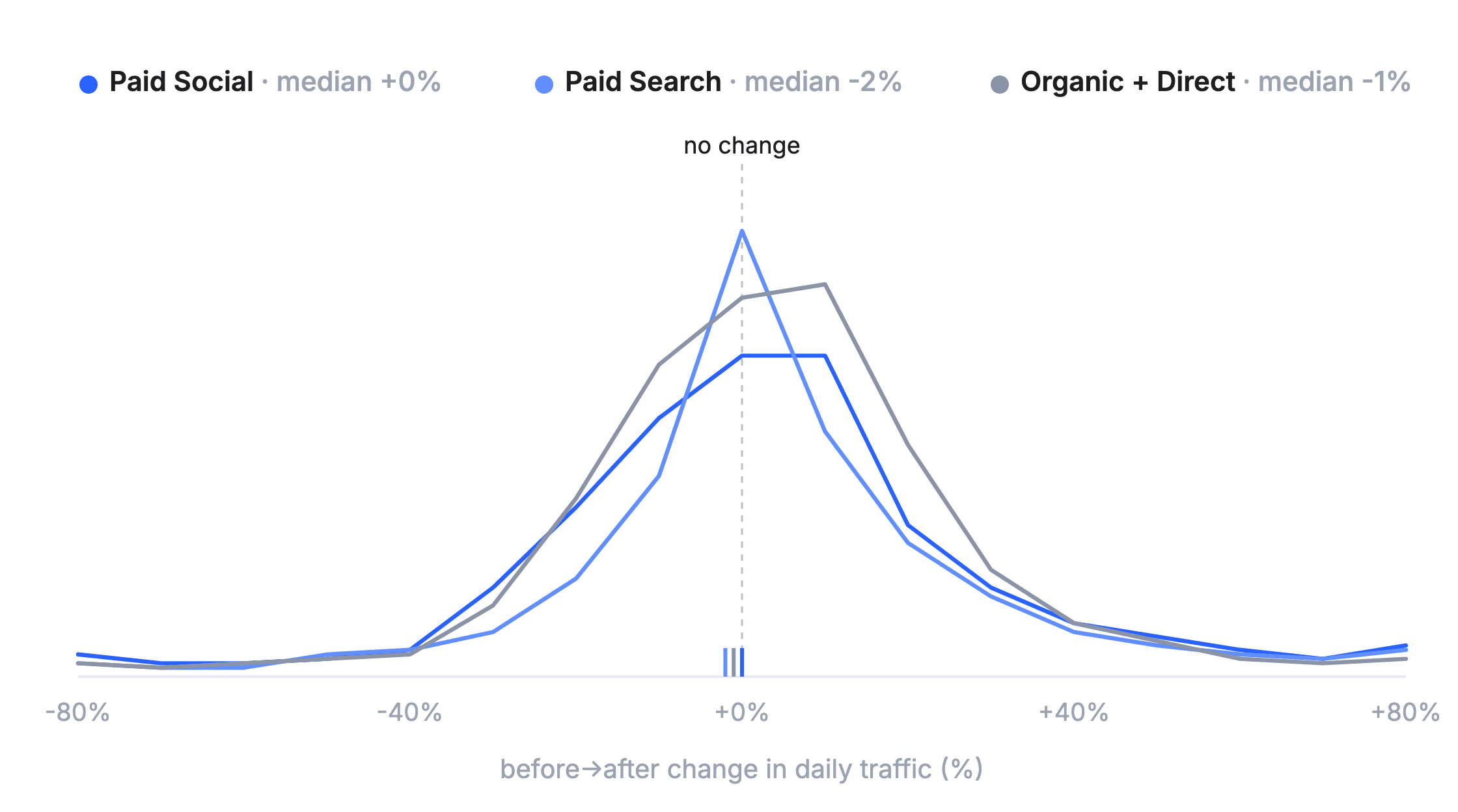
Before-and-after traffic change by channel across 157 launches. Paid and unpaid channels form the same bell, centered on zero.
Check 2: Do Paid Channels Actually React to the Tests?
Check 1 shows paid traffic doesn't fall on average. This is the sharper question: when a test genuinely changes conversion, does paid traffic move in response? If launching a test changed what Meta's algorithm sees, the tests that moved conversion the most should move Paid Social the most.
They didn't. Plot every test by how much it changed conversion against how much its Paid Social traffic moved, and the cloud is flat and centered on zero. The big-swing tests nudged paid no more than the quiet ones... no dose-response. Paid Search behaves the same way, so the small scatter isn't Meta reacting to anything. It's ordinary traffic noise.
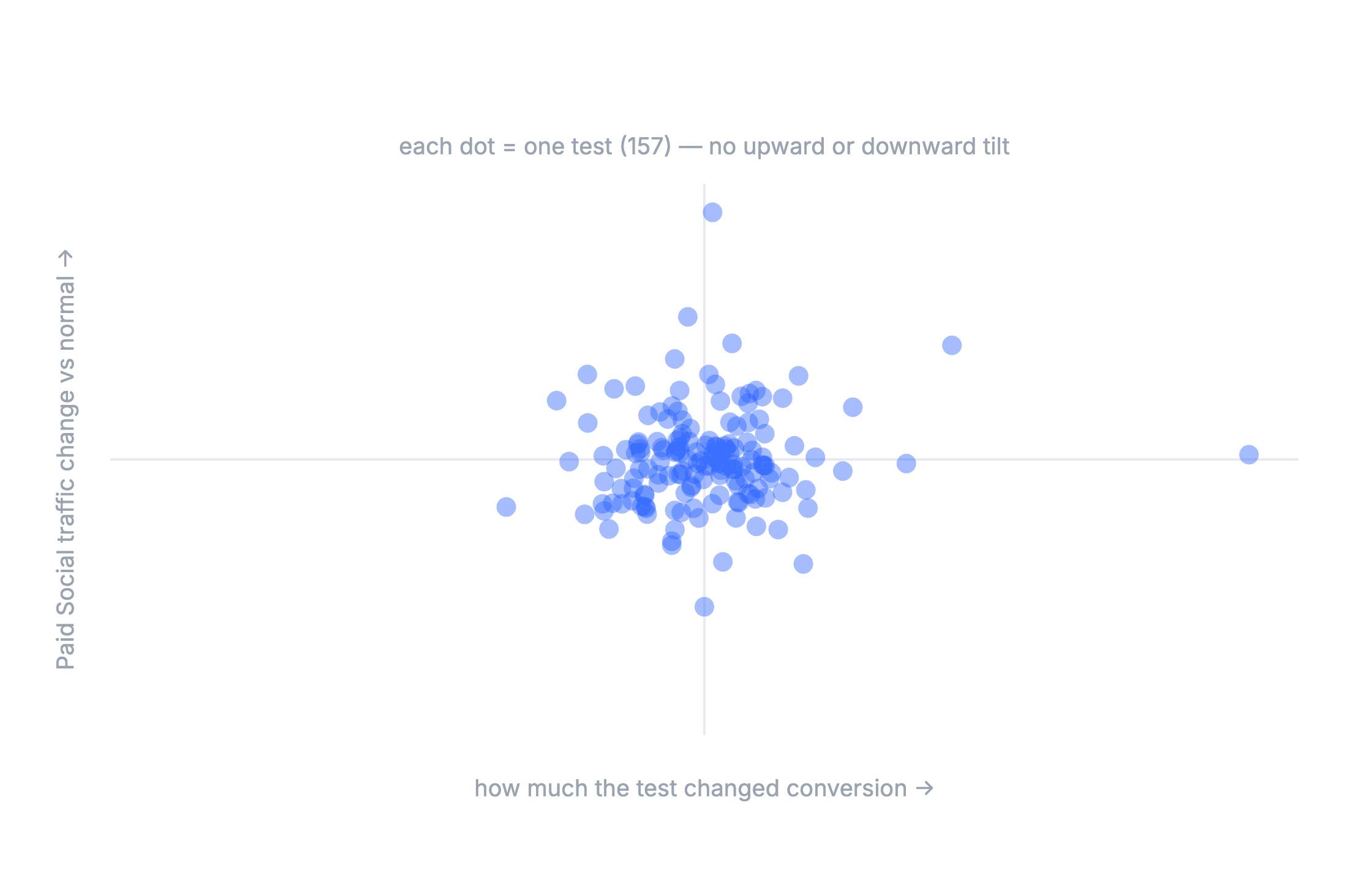
Each dot is one test. The tests that moved conversion most moved paid traffic no more than the quiet ones... a flat cloud, no dose-response.
Check 3: Does the Control Group's Conversion Slip?
If tests were quietly degrading the buying experience, the control group's conversion should drift below its normal baseline once a test goes live. So for each test we compared control-group conversion during the test to the store's conversion the month before.
It didn't deteriorate. The distribution isn't skewed negative... if anything it sits above baseline, because the visitors who qualify for a test tend to be higher-intent than a store's overall average. The signal that matters most is what control conversion tracks: it follows each store's own baseline closely (a 0.77 correlation) and shows almost no relationship to the size of the test's own effect (-0.03). It holds where the store already was, not where the test pushed it.
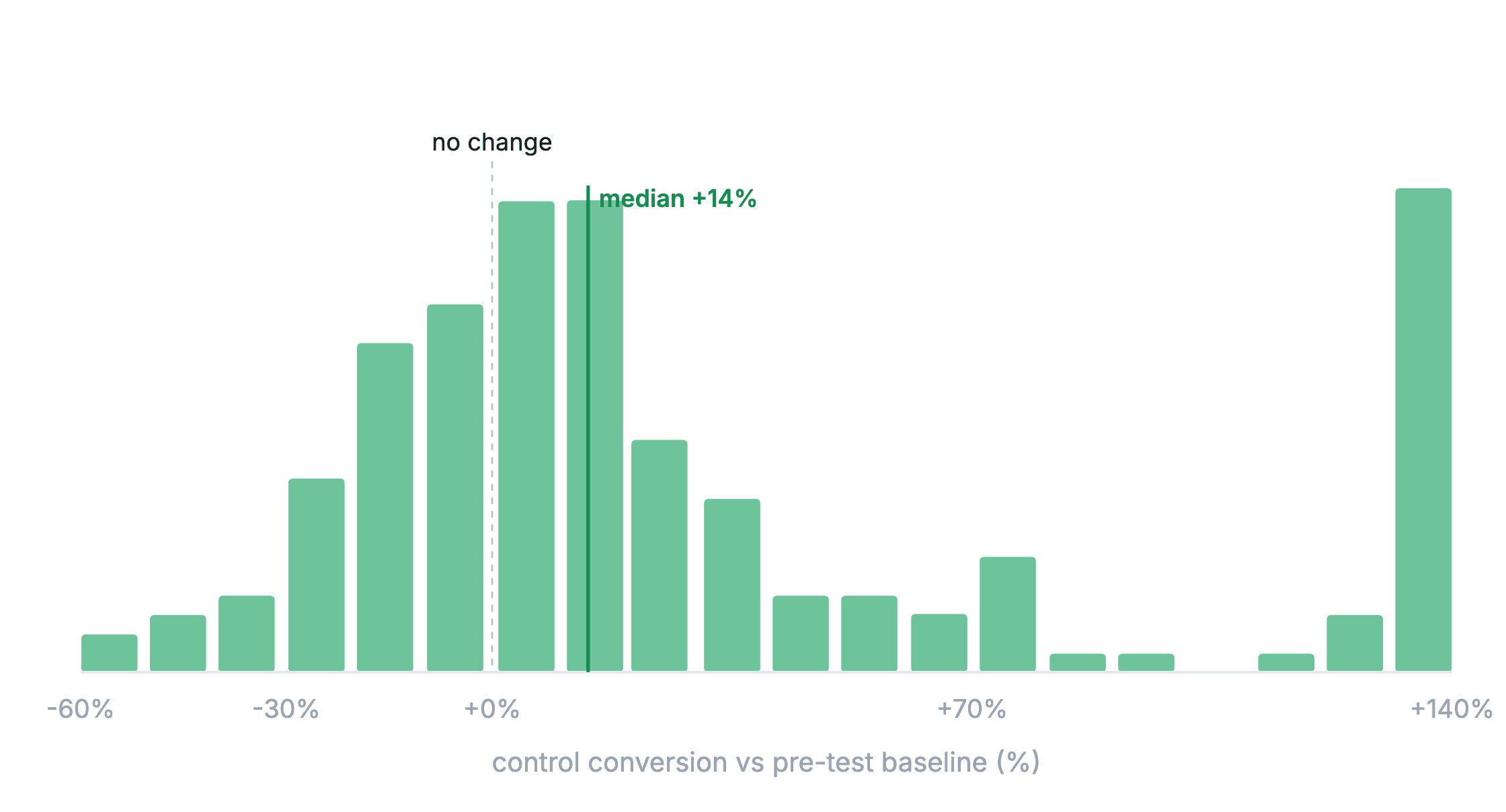
Control-group conversion versus each store's prior baseline. Not skewed negative... it sits modestly above baseline because test-eligible visitors skew higher-intent.
Check 4: What About the Most Invasive Tests?
Split-URL redirects and full-theme tests swap the entire experience, not just a price or a headline. If any test type were going to disturb paid channels, it would be these. So we re-ran Checks 1 and 3 on just that subset of 29 launches.
Paid traffic came back the same, with all three channels centered on zero and their medians at essentially no change.
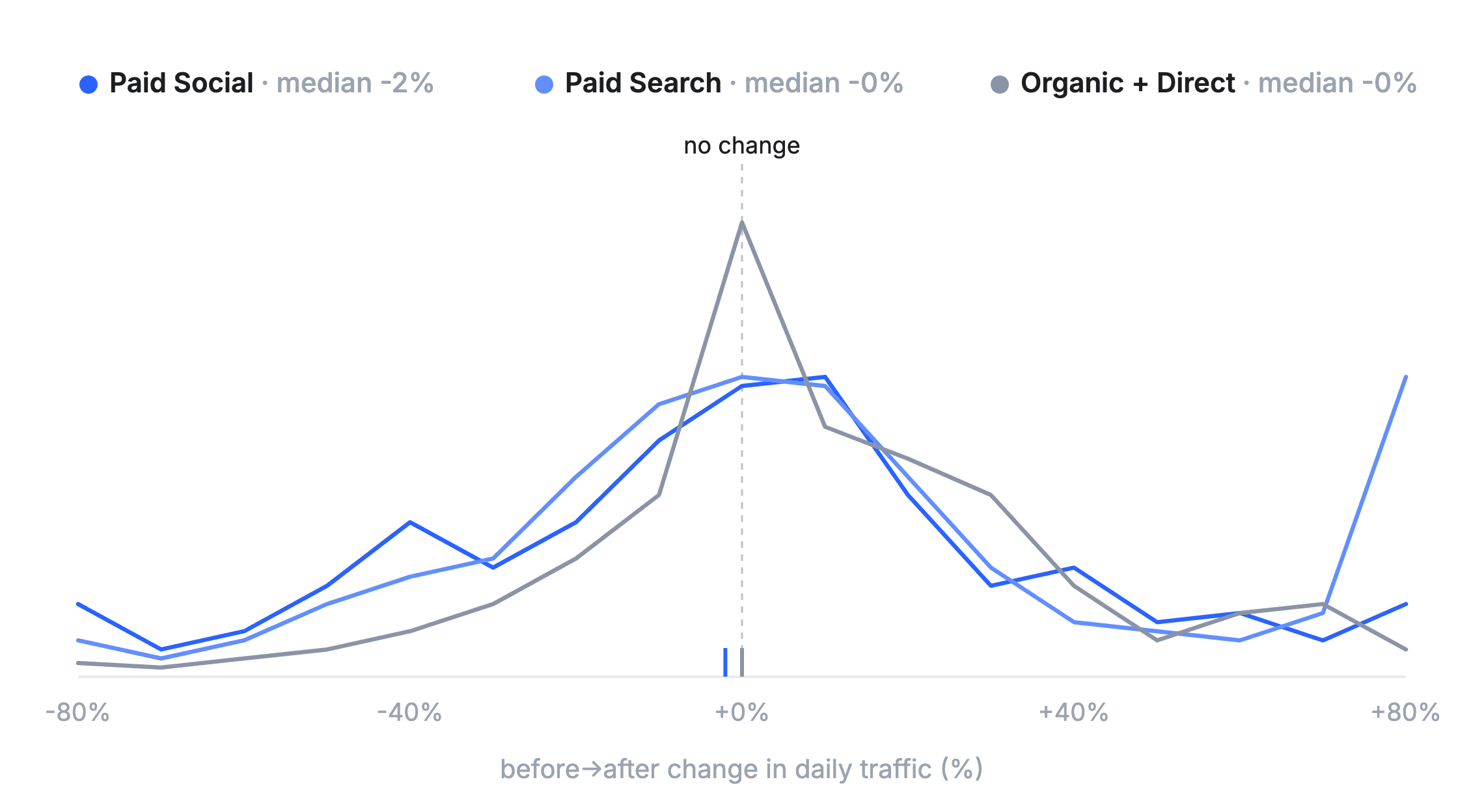
Redirect and full-theme tests only. The same bell centered on zero, even for the tests that change the most.
Control-group conversion held at baseline too, not skewed negative, exactly as it did across the full set.
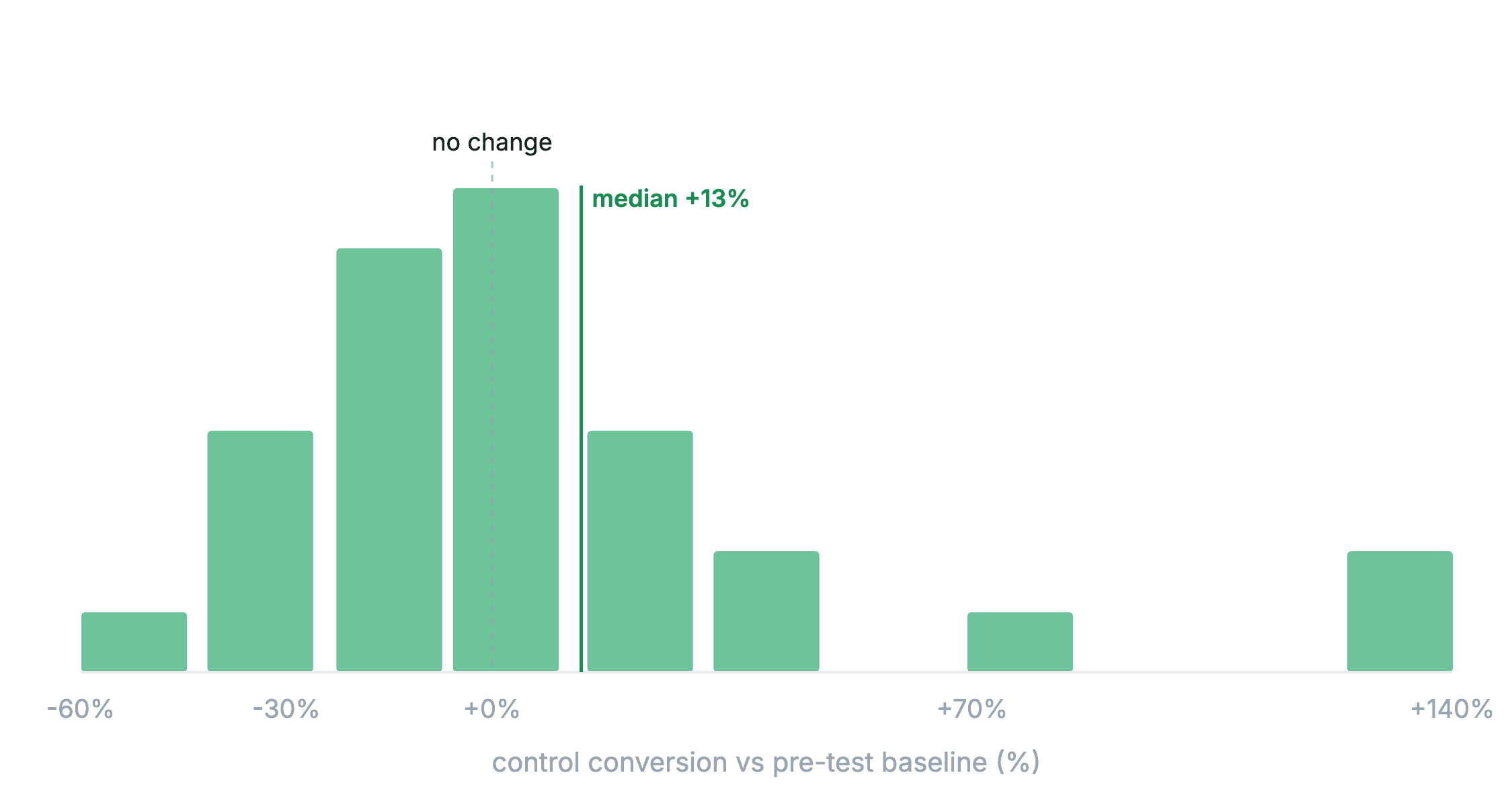
Control conversion for the same subset. Still centered near baseline, still not skewed negative.
The tests most likely to trip up an ad platform behaved no differently from the rest. That's the robustness check that makes the finding hard to wave away.
Check It on Your Own Store
You don't need our dataset to run a version of this. The numbers already live in your Intelligems account, and the quickest way to interrogate them is the Intelligems MCP, which connects your Intelligems analytics to an AI assistant like Claude. Instead of exporting spreadsheets, you can just ask in plain language... something like "compare conversion rate and revenue per session across my paid, organic, and direct traffic for the two weeks before my last test launch versus the two weeks during it." It pulls your channel-level numbers and runs the comparison for you. And if you manage a roster of brands, agencies can push the MCP even further.
The pattern to look for is simple. If a move shows up in paid and organic and direct at the same time, it's external... a seasonal shift, a sitewide change, a market move... not your test. If paid shifts on its own and tracks your CAC, that's the one worth digging into.
Where We'd Look Next
Good data science is honest about its edges, so here's what this study can't rule out, and where we'd look next.
It can exclude large, consistent swings, but not tiny ones... a very small effect could hide inside normal day-to-day variation. It also can't see ad spend and bidding directly. Meta could shift budget or bids without visit counts moving, and if a real effect exists anywhere, that's the likeliest place it lives. And it measured a one-to-two-week window around each launch, because brands test too frequently to cleanly isolate longer horizons.
What the data does settle is the version of the claim most people actually worry about: that running tests, as a category, quietly drags down your paid channels. Across 157 launches and four separate checks, that pattern simply isn't there. If you want to keep digging, the one place left to look is ad-platform spend and bidding data, pulled from Meta or Google directly. And a shift there is usually its own platform-side test... your bidding strategy doing its job, not something the on-site test caused.
So, Does A/B Testing Hurt Your Paid Channels?
We went looking for a systematic paid-channel tax across 157 tests, from four different angles, and it wasn't there. That doesn't mean you stop watching your channels, or that a one-off case can never happen. It means the broad fear... that testing quietly drags down paid... isn't backed by the data. If anything, the bigger risk is the profit you never find because the fear kept you from testing.
Price Testing
Ecommerce Strategy
AB Testing


