
Ecommerce Strategy
How Do I Know Which Products Are Actually Profitable?
Your sales report ranks products by what they bring in, not by what they keep. Build the profit ranking alongside it and the two rarely match, sometimes leaving your best-seller near the bottom. Here's how to build it and what to act on.

Carlos Trujillo

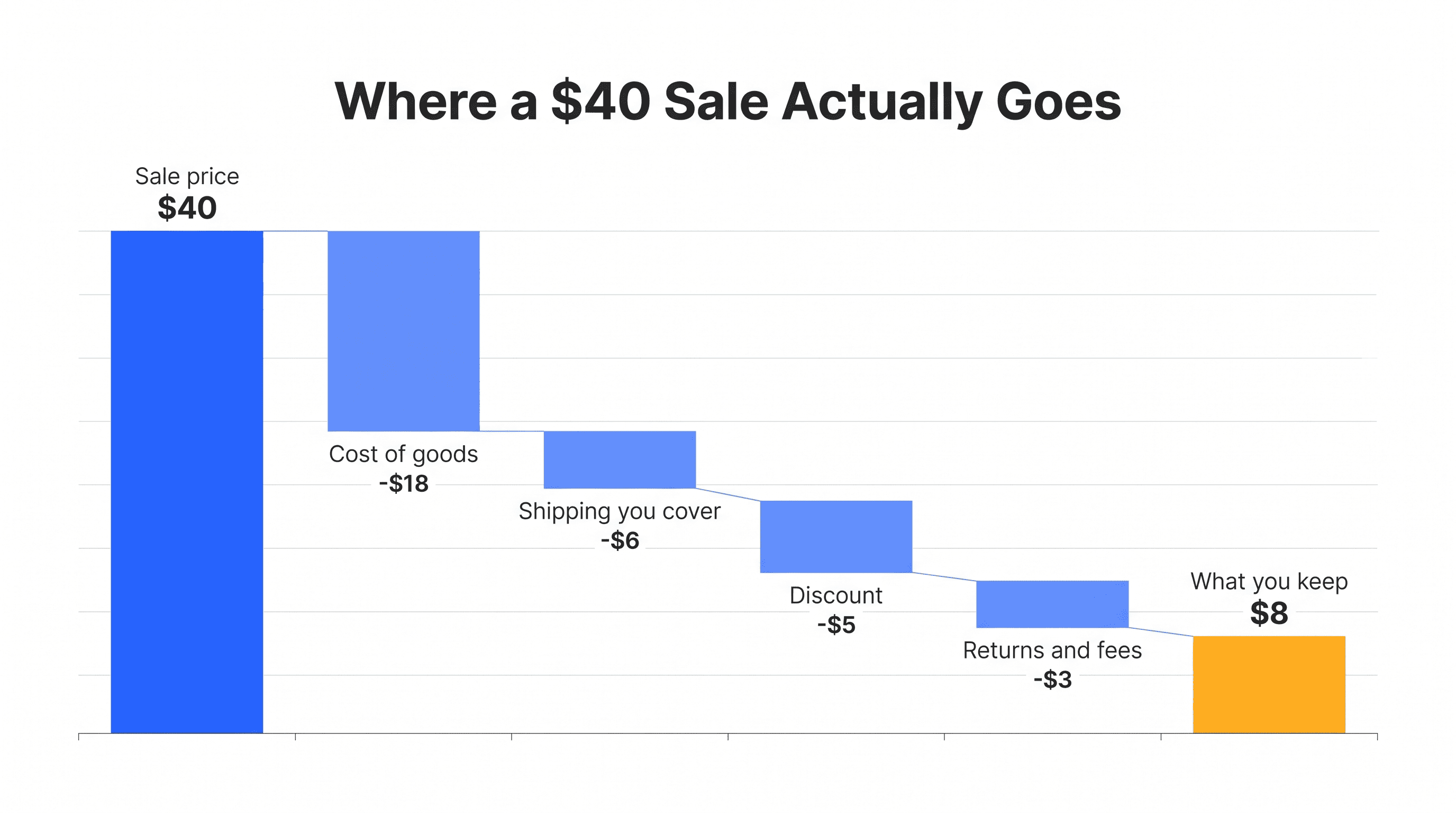
You already know which products sell the most. Which ones actually make you money is a different question, and the reports that answer the first one won't answer the second. Sales rank a product by what it brings in. Profit ranks it by what's left after the cost of goods, the shipping you cover, the returns, and the discounts come out. Rank your catalog both ways and the order can shift, sometimes sharply. The clearest place to see it is at the very top, where a best-seller can be moving serious volume on the thinnest margin you've got, working incredibly hard and holding onto very little. Here's how to build that second ranking, and what to do with what it shows you.
Revenue Rank and Profit Rank Are Two Different Lists
The revenue list is the one everybody already has. It comes out of a single report, it needs no assumptions, and it's the easiest number in the building to agree on, which is why it ends up on dashboards and in team updates. That familiarity is what makes it feel like a ranking of your most important products.
The profit list takes more work, and it rarely comes out in the same order. A product can top the revenue list and sink to the bottom of the profit list, and nothing about the revenue number would warn you.
The same blind spot shows up with AOV. A higher average order value is real progress when your conversion rate and margin hold steady. It's a mirage when the bundle or threshold that raised it costs more than it brought in. The number on its own can't tell you which one you're looking at.
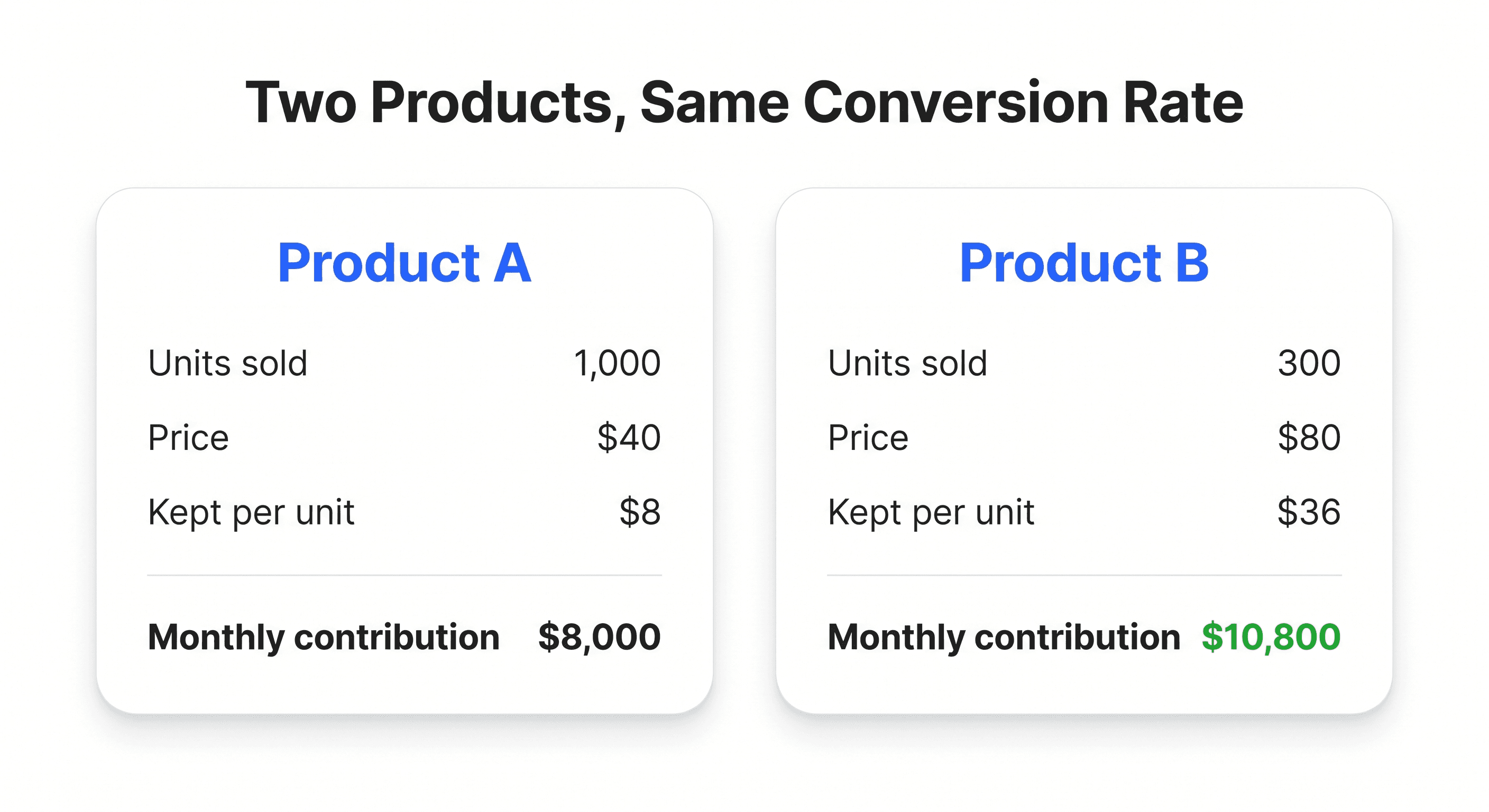
Two products can convert at the same rate and still land in completely different places once margin and returns enter the math. Picture one that sells 1,000 units a month at $40 with a slim margin after all costs, so it keeps about $8 a unit and contributes $8,000. Another sells 300 units at $80 with a healthier margin, keeps $36 a unit, and contributes $10,800. The quieter product earns more profit on less than a third of the volume. Now add a heavy return rate or a standing discount to the first product, and the gap gets wider fast.
What Makes a Best-Seller Quietly Unprofitable
A high-volume product can lose its edge in a few common ways. Each one leaves a trace in your data.
Thin margin at scale. Each sale keeps so little that only the volume is holding the number up. Lose a bit of that volume and the contribution collapses with it.
A discount it can't sell without. The "sale" price became the real price. Customers learned to wait for it, and the margin quietly eroded until the everyday number stopped meaning anything.
Returns and complaints that eat the margin. This is the classic "toxic" product. It can convert beautifully and still lose money once a chunk of orders come back to be processed, restocked, or written off, and the tickets and refunds cost you goodwill on the way out.
Shipping and fulfillment. Heavy or bulky items cost more to move, and if you're covering shipping to stay competitive, a popular low-margin product can turn into a popular subsidy.
It replaces something better. Sometimes a cheaper hero pulls sales away from a higher-margin option customers would have bought anyway. The best-seller wins the sale and the catalog loses the margin.
How to Build Your Profit Ranking
Start with every product, its units, and its revenue. Then bring in the numbers that reveal real profitability: gross margin per product, inventory sold, and how fast each item turns over. Layer in the costs revenue ignores, like the shipping you cover, the return rate, the discount depth, and payment fees. Getting profit into the same view as sales is worth the setup, and Intelligems has a guide on adding profit to your analytics so the numbers sit side by side.
Now re-sort by contribution profit instead of revenue, and put the two rankings side by side. The products sitting far higher on the revenue ranking than on the profit one are the ones worth your attention. That gap between where a product lands on each is the whole story.
Finding One Isn't a Reason to Kill It
A best-seller near the bottom of your profit list isn't a mistake to delete. It's a demand problem you've already solved sitting next to an economics problem you haven't, and that combination is worth more than it looks. A small change on a product that sells constantly compounds in a way the same change never would on a slow mover. You have three levers.
Reposition what you show. Your most profitable products deserve the prime spots, and a traffic magnet doesn't have to sit in the default slot forever. The first item in a collection often hasn't changed in years, so try leading with a higher-margin product or a bundle and watch what happens to the mix. Where a product sits is a merchandising decision, not a fixed fact.
Bundle around it. A high-traffic best-seller is a vehicle. Pair it with slow-moving inventory or a higher-margin companion and you can move stock that was sitting still while raising the value of an order the customer was already placing. That can turn a low-margin magnet into a distribution advantage instead of a drag. Watch the markdown inside the bundle, though, because a bundle can lift revenue per visitor and still compress margin if the discount runs too deep.
Fix the economics with a test. If the problem is price or discount depth, change it and measure rather than assume. Your highest-volume product is where a wrong guess costs the most, because if you're wrong, you're wrong at scale. A few paths worth trying, one variant at a time:
A small price increase. On a high-volume product, even a modest raise can add up quickly, and the real question is whether volume drops enough to cancel it out. Our data on whether raising prices hurts sales suggests fewer customers at a healthier margin can beat more customers at a thin one, though which way it breaks depends on your margin profile.
A smaller discount. If the product only sells on sale, find the smallest discount that still moves it. You might be paying for behavior a shallower discount would buy just as well.
The shipping math. If you're covering shipping on a heavy item, see what a threshold or a small shipping charge does to conversion and profit together.
Running those variants at the same time is what a tool like Intelligems is built for. Different visitors see different prices at the same moment, the price stays consistent through checkout, and nobody has to touch theme code. Because it pulls straight from your Shopify backend, profit sits in the same view as the test, so you read profit per visitor across the variants and roll out the one that keeps the most, rather than the one that sold the most.
Two things worth holding onto. A low-margin best-seller can still earn its place if it brings in new customers who come back for higher-margin products later. That can be a real strategy, but only if you've measured the downstream value, not assumed it. And none of the levers above are best practices. They're ideas to test in your own context, not answers to copy.
The team digs into why cost of goods belongs in every profitability decision, and what changes once you add it to the equation.
The Product Funding Your Store Might Be One Row Down
The best-seller label rewards the number that's easiest to see, and the easiest number to see is rarely the one that pays your suppliers. The costs are already sitting in your data, and a price or offer test tells you what a product does when you ask it to keep more. Once you know what each one is really for, you can decide which to protect, which to fix, and which to test first.
Expert Guide
Analytics
AB Testing


