
AB Testing
How to Increase The Conversion Rate of a Shopify Store
You want more visitors to buy. That's a reasonable goal, and conversion rate feels like the obvious metric to watch. More conversions means you're winning, right?
You want more visitors to buy. That's a reasonable goal, and conversion rate feels like the obvious metric to watch. More conversions means you're winning, right?
But conversion rate alone doesn't tell you if you're actually winning. It tells you one piece of a larger story. A store can increase conversion by 20% and still make less money than before. That sounds counterintuitive until you understand what conversion rate actually measures and what it leaves out.
The real question isn't "how do I get more people to buy?" It's "how do I increase profit per visitor?" That reframe changes everything about how you approach optimization.
Why Doesn't Conversion Rate Alone Tell You If You're Winning?
Higher conversion at lower margins can actually hurt your business.
Conversion rate measures the percentage of visitors who complete a purchase. It says nothing about what they paid, what it cost you to fulfill that order, or whether the transaction was profitable.
Consider this scenario: you run a 25% off sale and your conversion rate jumps from 2.5% to 3.0%. That's a 20% lift in conversion. Success, right? Not necessarily. If your profit margin was 40% before the discount and the sale compressed it to 15%, you're now making less money per order. And if your traffic stayed constant, that 20% conversion lift didn't offset the margin compression. You worked harder to earn less.
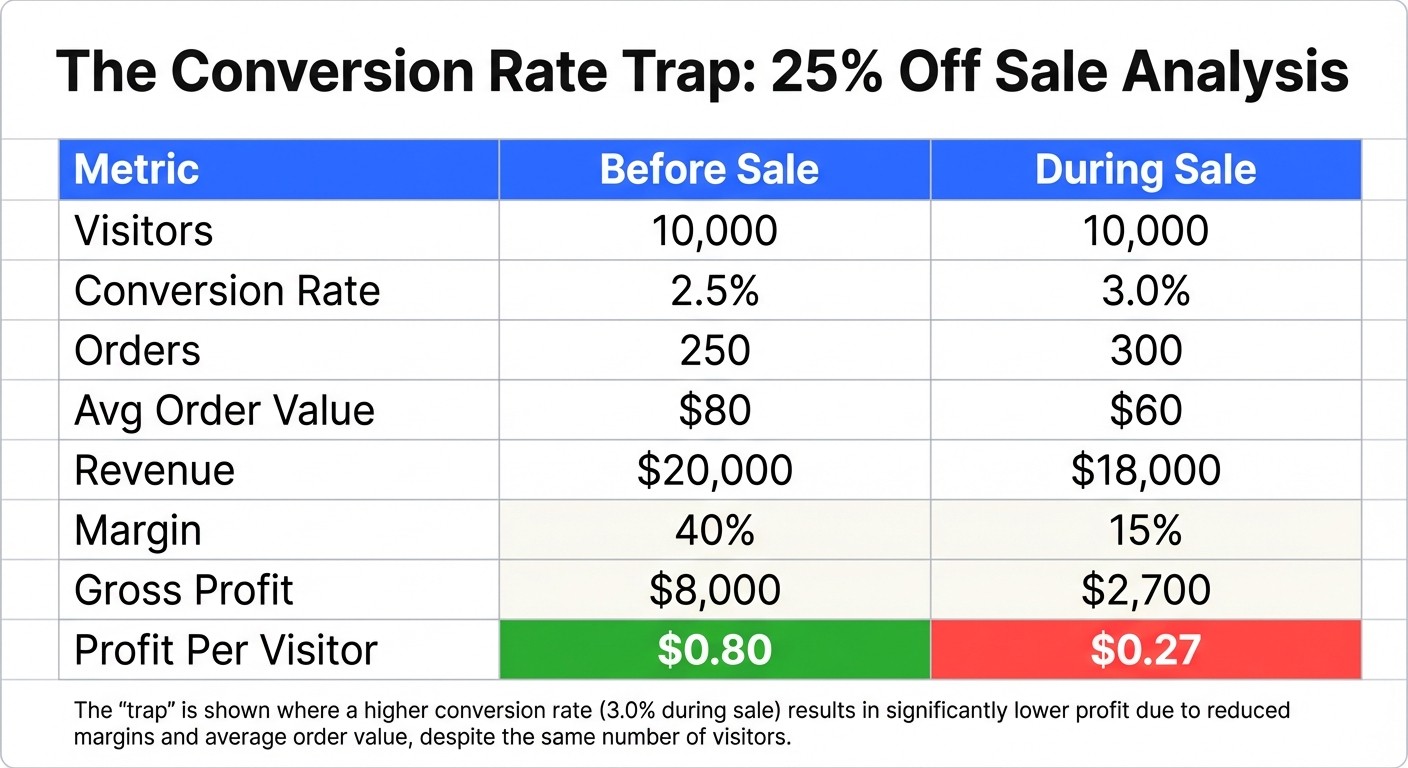
This is why profit per visitor matters more than conversion rate. Profit per visitor captures the full picture: how many people buy, what they spend, and what you keep after costs. You can have a lower conversion rate and higher profit per visitor. You can have a higher conversion rate and lower profit per visitor. The conversion number alone doesn't tell you which situation you're in.
When you're thinking about whether raising prices will hurt your sales, conversion rate is only one variable in the equation. The other variables matter just as much.
Understand how conversion rate optimization has evolved from pure conversion focus to revenue optimization to profit optimization, and why modern CRO requires understanding the full business equation.
What Signals in Your Data Reveal Conversion Opportunities?
Your data shows where friction exists.
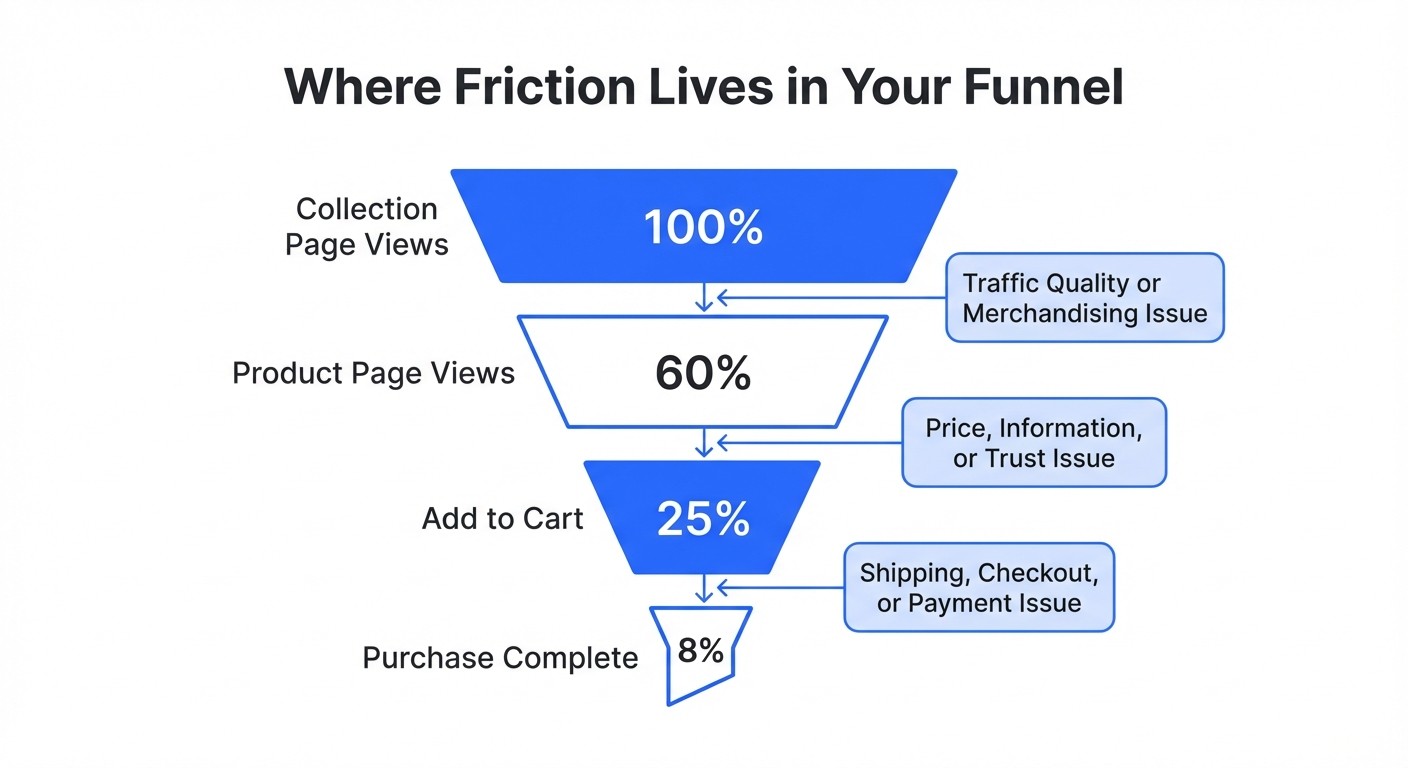
Before testing anything, look at where visitors drop off. Your Shopify analytics and any additional tracking you've implemented will show you the shape of your funnel. The shape tells you where friction lives.
If you're seeing strong product page views but low add-to-cart rates, something on the product page isn't working. That could be price perception, unclear product information, missing trust signals, or simply the wrong audience landing on that page. The data doesn't tell you which one, but it tells you where to look.
If you're seeing high add-to-cart rates but low checkout completion, the friction is later in the funnel. Shipping costs revealed at checkout, complicated checkout flows, or payment concerns could all contribute. Testing what your free shipping threshold should be can directly address this friction. Again, the data points you to the problem area.
If you're seeing visitors bounce quickly from collection pages, they may not be finding what they expected. That's a traffic quality issue or a merchandising issue, not a product page issue.
Each pattern suggests a different type of intervention. Reading the data first prevents you from applying generic tactics to problems you don't actually have. There's no point optimizing your checkout if visitors aren't adding products to their carts in the first place.
What Can You Actually Test?
Test the friction point your data reveals.
Once you've identified where visitors drop off, you can design experiments that address that specific friction. The key is measuring profit per visitor as your success metric, not just conversion rate.
If product page engagement is high but add-to-cart is low, you might test:
Price presentation (showing value more clearly, not necessarily lowering price)
Product imagery or information depth
Trust signals like reviews, guarantees, or shipping clarity
Urgency or scarcity messaging
If add-to-cart is healthy but checkout completion lags, you might test:
Showing shipping costs earlier in the journey
Simplifying the checkout flow
Adding payment options or trust badges
Addressing cart abandonment with different messaging
Understanding how to reduce checkout abandonment can help you identify which of these levers to pull first. You can also learn how to test checkout experiences to validate what actually works for your specific audience.
Real test results reveal that trust badges can actually hurt conversion, and that the most effective checkout experiences maintain congruency with your ad messaging all the way through purchase.
The important distinction: you're not just testing whether these changes increase conversion. You're testing whether they increase profit per visitor. A change that lifts conversion 10% but requires offering free shipping that costs you 15% of margin isn't a win. You need to measure the full impact.
This is where understanding how to know if your prices are right becomes essential. Price is the highest-leverage variable in your business. Small changes in price create large changes in profit. Testing price against profit per visitor (not just conversion) reveals opportunities that conversion-only thinking misses entirely.
What Mistakes Should You Avoid?
Don't optimize for the wrong metric.
The first mistake is chasing conversion rate as an end goal. Conversion is an input to profit, not the output that matters. Every decision should be evaluated against profit per visitor, not just whether more people clicked "buy."
The second mistake is applying generic tactics without understanding your specific friction. "Add trust badges" is common advice, but if your visitors aren't even reaching the checkout, trust badges won't help. Diagnose before you prescribe.
The third mistake is copying competitors without testing. You don't know if their tactics are working for them. You don't know if their customers are similar to yours. You don't know if they've actually measured the impact. Running your own experiments gives you answers specific to your business.
The fourth mistake is not measuring profit per visitor at all. If you're only tracking conversion rate and revenue, you're missing the most important number. A 3% conversion rate at $50 average order value with 20% margin produces very different economics than a 2% conversion rate at $80 average order value with 45% margin. Profit per visitor captures what conversion rate cannot. Make sure you're using proper experiment analytics to see the full picture.
Stop Guessing. Start Knowing.
Conversion rate optimization isn't about following a checklist of tactics. It's about understanding where friction exists in your specific funnel, testing changes that address that friction, and measuring success by the metric that actually matters: profit per visitor.
Remember:
Conversion rate is an input to profit, not the goal itself
Higher conversion at lower margins can hurt your business
Your data reveals where friction exists before you test anything
Every test should be measured against profit per visitor
Generic tactics without diagnosis waste time and money
Don't guess how to improve conversion. Know.
Ready to discover what's actually driving profit for your Shopify store? When you're ready to know for sure, let's get you testing beyond what's typical.
AB Testing
AB Testing
AB Testing


